How Much Does It Cost to Develop a Logistics App in 2026?

You may not believe it, but because of downtime and operational breakdown, many supply chain and transportation companies lose more than $15 million every year. The large-scale enterprises and private carriers struggle with freight loss because they don’t have the ideal load capacity. These are the major factors causing the increase in prices and withdrawal of logistics businesses from the industry. And because of these challenges, logistics applications came along. 

Consulting with the leading logistics app development companies, the supply chain and associated businesses have come a long way and eliminated all the challenges. Today, the number of businesses switching to logistics apps has increased to a market size of $25.22 billion. As per the following graph, logistics app development is predicted to have a favorable impact with the rising demand for safe and sustainable transportation. 

The global digital logistics market size is expected to reach $77.52 billion by 2030, with a CAGR of 17.54%. The following graph describes the same. 

According to recent statistics, logistics/trucking holds the highest market share of 35%. This is something that puts the future of logistics app development in the spotlight. 

These were the logistics market insights. Now, let’s get an idea of the cost of developing a logistics app for your business.

The Different Types of Logistics Apps

(1) Fleet Management – Monitor vehicle performance, fuel usage, routes, and maintenance schedules using these apps. 

(2) Logistics On-demand – These apps connect customers with delivery providers, similar to Uber but for packages.

(3) Warehouse Mobile Apps – To manage inventory, automate restocking, and optimize warehouses, these apps will help you. 

(4) Tracking and Forwarding Applications – These apps provide real-time updates of shipments, automate documentation, and streamline forwarding operations. 

Why Should You Invest in a Logistics App? 

According to the US logistics businesses, having a mobile application is necessary to stay ahead in the competition because 

  • Real-time tracking encourages transparency and trust with customers 
  • Automation reduces human error and speeds up operations 
  • Data analytics ensures firm decision-making 
  • Improve customer experience and help to retain them

Logistics apps can also be a revenue generator for businesses. Thus, partnering with leading and experienced mobile app development companies is necessary.

How Much Does it Cost to Develop a Logistics App in 2025 

The logistics app development cost relies on the features you want, the technologies you choose, and even the geolocation of the company or offshore team. But the average cost to develop a logistics app in 2025 is as follows: 

(1) Back-End and Front-End Development 

The front end focuses on the UI/UX of the application that the user interacts with. It must be fast, intuitive, and compatible across all devices (desktop, mobile & tablets). Supporting user data, APIs, GPS tracking, notifications, and 3rd-party integration comes under back-end development. 

For front-end, most businesses are choosing React Native and Flutter. And for back-end development, they like Node.js and Python more. The following is the cost breakdown based on complexity:  

Basic Features ~$15,000–$40,000
Advanced Features + real-time tracking ~$50,000–$100,000
Enterprise-grade + AI/IoT integrations ~$100,000+

(2) Choice of the Tech Stack 

The choice of the tech stack affects the cost, performance, and scalability of the logistics app. The most preferred tech stacks of 2025 are 

  • Front-end – Reach Native, Flutter 
  • Back-end – Node.js, Django 
  • Database – PostgreSQL, MongoDB 
  • Hosting – AWS, Azure 
  • Others – Firebase (notifications), Twilio (SMS), Stripe (payments) 

The advanced tech stack means a higher development cost, but the payoff is better performance and long-term scalability. 

(3) Type of Application 

The type of application decides the required functionalities and the corresponding budget. 

Type of AppRequired functionalityApproximate Budget
Fleet Management AppGPS integration, driver analytics, maintenance alerts ~$50K–$90K
On-demand App Real-time driver assignment, payment gateway ~$70K–$120K
Warehouse App Barcode scanning, inventory syncing ~$60K–$100K
Tracking App Shipment visibility, geofencing alerts ~$40K–$90K

(4) Platform (Android or iOS, or Both) 

AndroidPopular for field operations 
iOSPreferred by enterprise users and executives 
Both Ideal for customer-facing apps and global usage 

(5) Development Team Size 

Rates in the USA (in 2025) for in-house teams are high, so many businesses opt for outsourcing or hybrid models. 

Team size Requirements Average rate 
Small Team Project Manager + 1 Dev + 1 QA ~$20,000–$40,000
Midsize Full-stack Dev + Designer + QA + Project Manager ~$50,000–$100,000
Specialists Full-fledged team with AI/IoT specialists ~$100,000+

(6) Location of Offshore Team 

The location of your remote or offshore team heavily influences the cost of the logistics app. 

LocationsHourly Rates
Northern Europe $50-75
Central Europe $25-50 
Asia $20-24
North America $150-200
South America $25-49
Australia $100-150
Africa $25-45

How Much Does It Cost to Develop an App Based on Development Stages?

(1) Strategy Stage 

Researching the market and competitors, or strategy, means marketing analysis, business plan, and documentation. 10% of the total mobile app development cost goes to this stage. 

The final document must have: 

  • Competitive analysis
  • Objective declaration
  • MVP concept
  • User and market research
  • A clear project roadmap

Estimated cost – $1,200 – $11,000
Timeline – 2 to 4 weeks

(2) Design Stage 

This stage is all about software prototyping and wireframing, user experience design, and visual (UI) design. Almost 10-15% of your total budget will go to this stage. 

Estimated cost – $2,500 – $10,000
Timeline – 3 to 4 weeks

(3) Development Stage

This is the most important and most complex stage of the logistics app development process. The complex features take more time and incur more cost. Not just features, this stage needs you to focus on the architecture of the app, data encryption, storage, user base, 3rd party integration, etc. 

Estimated cost – $3,000 – $60,000
Timeline – 2 to 6 weeks

(4) Testing and Deployment Stage 

Testing validates the quality of the app you build so that your customer will face fewer or no issues in terms of crashes, glitches, and lag. 

Estimated cost – <$5,000
Timeline – 2 to 4 weeks

iQlance Solutions, being a leader in mobile app development company in the USA and delivering local services in Dallas, Texas, Houston, and New York, provides you with a complete breakdown of your logistics app development process to ensure transparency.

What Technologies Should You Use for Logistics App Development 2025?

Blockchain

Blockchain secures freight documentations, payment trails, and transaction logs. It helps eliminate fraud and increase data transparency. According to the research. The US blockchain in logistics is expected to reach a market size of $2.23 billion by the year 2027, with a CAGR of 39.78%. 

Internet of Things (IoT)

To get real-time data like the temperature and location of a shipment or the fuel of a vehicle, IoT helps users by connecting sensors in the vehicle. The IoT-powered logistics market in the USA is valued at $9.43 billion; it is projected to grow with a CAGR of 41.8%. Moreover, it will grow to $218.57 billion in 2034. 

Artificial Intelligence (AI) & Machine Learning (ML)

AI suggests optimized routes, while ML can forecast demand that helps logistics companies better allocate resources. The US AI in logistics market size already reached $8.85 billion in 2025, while it is projected to grow to $242.43 billion by 2034, at a CAGR of 44.69%. 

5G Connectivity

The 5G connectivity ensures high-speed, low-latency communication between all the devices, and it’s highly adaptable for tracking shipments. Almost half of the logistics companies in the USA started investing 1 to 10% of their annual IT budget in 5G rollout and integrations. 

iQlance Solutions, a leading logistics app development company, provides services in all the trending technologies in the USA. Connect with us to know more about our services. 

How to Save Money on Logistics App Development?

(1) Start with an MVP: Build a basic version with core functionalities, gather user feedback, and then work on it. This approach will save your money and allow you to build only the necessary features. 

(2) Use existing solutions: You can use pre-built APIs, SDKs, and cloud services to cut the cost. For example, for tracking, you can use Google Maps. 

(3) Follow Agile methodology: If you do not want to take a risk on your budget, you can go with the agile method. You will get continuous feedback, feature prioritization, and quick changes by adopting this method. 
(4) Outsource wisely: Partner with a company that has transparent pricing and hands-on experience in building logistics apps.

How Can iQlance Solution Help You Optimize the Cost as a Leading Logistics App Development Company?

As a leading mobile app development company in the US, we know logistics companies need not only cutting-edge technologies but also cost-effective strategies. Here is how we help them by optimizing the cost of their logistics app without compromising on performance, quality, and user experience. 

Understanding your Requirements

Before jumping to the coding phase, our seasoned logistics app developers understand the business model, workflow pain points, and end-user needs thoroughly. This initial groundwork eliminates the scope of surprise costs and ensures delivering value from the first phase of development.

Choosing the Right Technology

Choosing an ideal tech stack can affect cost and performance. Our expert developers assess your requirements and recommend the most scalable and budget-friendly technologies.

For example, we suggest Flutter for cross-platform development that reduces duplication across Android and iOS. Or opt for a Firebase over custom backend development for fast deployment with low costs. We also recommend impactful technologies like AI for route optimization or IoT for shipment tracking.

Providing a Detailed Proposal

To ensure transparency, we provide a detailed proposal including:

  • Estimation of each development phase 
  • Timeline and delivery phases 
  • Technology selection and justification 
  • Maintenance and support

Offering a Cost-effective Solution

Our hybrid model offers US-based strategic consultation combined with offshore development excellence. This ensures our clients get the quality and communication standards of a local agency at significantly lower development rates.

Providing Regular Updates

We follow Agile and Scrum methods to deliver high-quality results in small and manageable sprints. Every week, our clients receive progress reports, live demos, and backlog planning to ensure they have full control over their project.

However, if they need any updates in between two sprints, they will connect to our team over the pre-defined communication channel. This feedback loop saves time and money. 

Testing and Quality Assurance

Quality issues can blow up the budget quickly. Hence, we integrate automated testing tools, manual QA checks, and performance benchmarking at every phase. 

Post-development support

We offer post-launch support, including:

  • Bug fixes 
  • Platform updates 
  • Feature improvement/expansion 
  • Server monitoring and many more.

Conclusion

Having a digital presence in 2025 is not about getting success without doing anything; it is about staying ahead of competitors by having a scalable app to manage everything in one place. The development cost varies based on your goals, technology choice, and execution strategy. But an experienced and leading logistics app development company helps you by suggesting necessary features, technology, and platforms, ensuring transparency, and providing end-to-end development support. 

Ready to turn your logistics app idea into reality? Request a Quote today and get a tailored solution for your business needs.

FAQs 

How do I choose a logistics app development team?

Choose a team having hands-on experience, strong technical skills (IoT, AI, GPS), a proven portfolio, a transparent pricing structure, and reliable post-launch support. Prioritize the mobile app development company that follows agile practices and understands the US market needs. 

What services does iQlance Solutions offer for logistics app development?

iQlance Solutions offers end-to-end logistics app services, including business analysis, UI/UX design, cross-platform development, real-time tracking, AI integration, third-party system integration, testing, deployment, and ongoing support.

How much does it cost to develop a logistics app?

The average cost of logistics app development ranges from $15,000 to $150,000+. However, it completely depends on the tech stack, feature complexity, and many more. 

The Ultimate Guide to Hiring Developers for Your Business in 2025

Hiring a talented software developer or choosing the best software development company is not just a technical requirement; it is now a critical decision for your business. Whether you are a startup, a growing business, or a well-established one, the ability to hire software developers effectively can decide the speed to market, product quality, and success. 

Let me be brutally blunt here: hiring developers today is harder than ever! 

You have to battle with sky-high salary expectations, compete with tech giants for talent, face regulatory hurdles, and, other than that, you have to be fast, or you will lose the best talent. I guess I don’t need to mention that hiring the wrong team can cost you more than just time. It will drain your budget like anything and can cause the delay of our product launch indefinitely. 

What are the Challenges Business faces when hiring developers? 

It is actually tough to find someone who is both qualified and willing to join your team. The following are the core challenges you should be aware of when deciding to hire software developers

(1) Scarcity of Skilled Developers 

The demand for skilled developers, especially in AI, blockchain, and React Native mobile apps, has far outpaced supply. The US-based companies often struggle with finding talent that meets their technical as well as domain-specific requirements. 

According to the Forbes study, there will be a shortfall of over 4 million well-paid developers in the current year, while the US Bureau of Labor Statistics shows almost 200,000 developer jobs will need to be filled every year by the end of the decade. 

(2) High Cost of Talent 

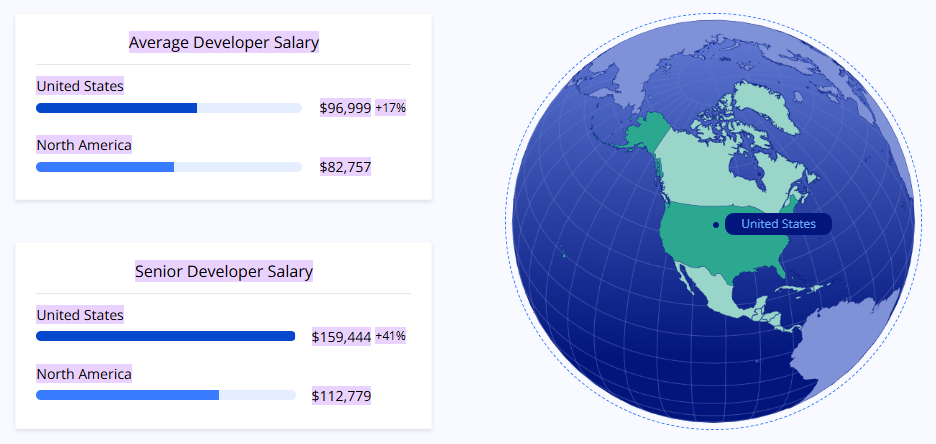
Hiring full-time senior developers, especially in the US, can command 6-figure salaries. It is difficult for startups or mid-sized firms to afford these huge salaries and stay competitive without blowing their budget. The following image shows the average salary and the senior developer salary in the United States. 

(3) Cultural Fit 

It is not just about the coding skills of the developers, but they must also align with your company’s values, communication styles, and culture. You have to look at everything, especially when choosing hybrid or remote teams. 

(4) Rapid Technological Change 

Walking with the tech trends is necessary for companies. The coders need to learn cutting-edge technologies like artificial intelligence (AI), machine learning (ML), the Internet of Things (IoT), and blockchain. Also, they need to know how to integrate these technologies with software development and make it a tech-rich one. 

(5) Assessing Potential Over Experience 

Startups mostly look for an individual who takes the initiative and fulfills the need for more than one role within the organization. Here, accessing their potential, adoptability, experience, and other factors will be beneficial for both. 

(6) Time Constraint 

Hiring does not happen overnight; it takes time. Starting with interviews, then assessments, and then the onboarding process, employers can take weeks or even months to fulfill just a single role. During this time, your product’s roadmap suffers. 

(7) Limited Network 

Access to a large talent pool or hiring networks is impossible for startups or mid-sized businesses. Without a pipeline of vetted candidates, most rely heavily on traditional hiring platforms, which may not be sufficient or may not deliver high-quality leads. 

(8) Regulatory Ad Compliance Issue 

Hiring globally or internationally involves tax, labor, and compliance complexities. US-based companies must tread carefully to stay within the legal boundaries. 

The Types of Software Developer Teams You Should Know 

Deciding on the type of team for your software development requirement is essential. Various team structures have their own advantages and challenges. The following are the various types of software development teams. 

(1) In-house development team 

These types of development teams have developers who are engaged full-time by companies. They are either working from the office or remotely under direct supervision. 

Advantages: 

  • Full control over team management, project timeline, and company culture.
  • Strong collaboration and faster internal communication.
  • Greater alignment with business goals, vision, and brand voice.

Challenges: 

  • Higher cost due to salaries, benefits, infrastructure, and overheads.
  • Longer hiring process and onboarding time.

(2) Freelance developers

The most independent working professionals are freelancers. Companies nowadays are hiring freelancers for a particular work or on a short-term basis.

Advantages: 

  • Cost-effective for small tasks, bug fixes, or MVPs.
  • Easy to hire for short durations or specialized skills.
  • Wide global talent pool with niche expertise.

Challenges

  • Freelancers may drop off projects unexpectedly. 
  • Lack of accountability due to limited oversight or commitment.
  • Difficult to scale or manage in larger, long-term projects.

(3) Outsourced development team 

Outsourcing the project means hiring a software development company to handle end-to-end development requirements. Outsourcing includes everything from planning to development, quality assurance, and deployment. 

Advantages:

  • Get full-service teams for your project (developers, designers, testers, PMs).
  • Cost-efficient, especially when working with offshore teams.
  • Faster time-to-market as work will be divided within a single team

Challenges:

  • Time zone differences (if offshore) may affect communication.
  • Cultural differences can impact workflows if not managed properly.
  • Requires clear documentation to avoid scope creep and miscommunication.

(4) Hybrid Team 

The hybrid means a mixed model of in-house developers with freelancers or an outsourced team. These types of teams balance control with scalability.

Advantages

  • Scalable and flexible because the core tasks stay in-house, while overflow work is outsourced.
  • Cost savings by reducing the in-house load for non-core activities.
  • Risk diversification minimizes reliance on one hiring model.

Challenges

  • Coordination complexities due to multiple team structures.
  • Different work cultures and tools may affect productivity.
  • Security concerns arise if access management isn’t tight across all teams.

(5) Dedicated development Team

This model is simply an extension of your in-house team, which is provided by an external software development company. You will get a full-time, remote team working exclusively on your projects. 

Advantages

  • Focus and commitment, as the team is dedicated to your product only.
  • Lower costs than in-house hiring (especially offshore).
  • Seamless integration with your existing workflows and tools.

Challenges

  • Onboarding time is still required to align with your business.
  • Dependence on the vendor for talent quality and management.
  • Initial coordination may take time to establish a strong workflow.

Read Blog : Custom Software Development Cost in 2025: A Complete Guide

8 Strategies to Hire Software Developers for your business 

It’s 2025, and today there is no space for posting a job and waiting for an application. Instead, we have to choose a thoughtful strategy by choosing the right platform where you can directly contact a developer or an offshore software development company. The following are some strategies to hire software developers for your business that most US-based companies follow:  

(1) Define Clear Project Requirements

Having a clear understanding of your requirements is necessary before starting to hire software developers. Having a clear idea of the technical skills, experience, and specific expertise requirements you need from individuals is something you must decide before starting. For example, if you want to hire an offshore mobile app development team to build a mobile app, then you need developers who have experience in iOS, Android, and React Native app development.

Your requirements determine the way to find developers for your business. Hence, first list down what you are looking for. And doing this will save your time and energy by narrowing down the large talent pool. 

(2) Use Developer-Focused Job Platforms

The best way to hire a software developer is by using developer-focused job platforms. The following are some websites that you should try: 

  • Stack Overflow Jobs – Popular among back-end and full-stack developers
  • GitHub Jobs – Ideal for developers with public code contributions
  • Toptal & Arc.dev – For pre-vetted elite freelancers and remote professionals

According to the study by Lemon.io, the global software development spending will grow by 9.3% in 2025; hence, the competition will also increase. Using particular job platforms (according to your requirements) ensures you are reaching the right audience. Moreover, you can narrow down candidates based on experience, location, and other criteria according to requirements. 

(3) Engage with Developer Communities

You will get access to the goldmine of developers using this strategy. Participate in online forums like Stack Overflow, Reddit’s developer subreddits, or local meetups that help you network with developers. These communities share insights and often give you a chance to see developers in action, sharing their knowledge and answering questions.

Having a part of these communities means interacting with developers who are not actively looking for jobs/projects, but they might be open to new opportunities. It is predicted that developers of these communities are up-to-date with the latest trends and best practices. 

(4) Consider Remote and Offshore Developers

According to recent studies, more than 75% of companies plan to outsource IT services, with the most common areas being app and software development, cybersecurity, etc. Hence, the demand for software developers in the US is expected to grow by 22% in 2030. 

While hiring developers, do not restrict yourself to a specific location. Hiring remote developers might mean getting access to a wide range of skill sets, especially in the tech hubs globally, where developers may have a unique focus or specialty. Yet, it is important to have clear communication and collaboration tools to ensure smooth workflow and qualitative work compilation. 

(5) Leverage Coding Competitions and Hackathons

Hackathons and coding challenges help you to know about developers’ problem-solving skills under pressure. You can consider platforms like 

  • HackerRank
  • TopCoder 
  • CodeSignal 
  • Kaggle (for AI/ML projects)

These platforms are best for finding hidden talent. You can review candidates’ code, logic, and creativity before even speaking with them. Nowadays, many companies are sponsoring these types of events where they can approach the best developers for their software development team. 

(6) Partner with Tech Talent Agencies

A staffing and talent agency specializing in IT is another option to fill the vacant position in your software development company. They maintain a database of pre-screened, experienced developers and can match your requirements with candidates based on skills, availability, and budget. The following are some benefits of using an agency for hiring developers: 

  • Save time in screening 
  • Quick hiring cycle 
  • Lower risk with contract-to-hire options 
  • Shortlisted profiles have a verified background 

(7) Use AI and Automated Hiring Tools

I know, you won’t believe it! But almost 95% of hiring managers are indeed using AI in the hiring process. 

Using advanced AI and ML tools, hiring managers can streamline the hiring process for developers. These tools work on an algorithm-based approach to analyze candidate profiles, assess their skills, and match them with the requirements of their business. This process is super quick and accurate compared to the manual one. Moreover, it also removes the bias from the hiring process. These tools are especially useful when you’re hiring at scale or for time-sensitive roles.

(8) Look for Developers with Startup Experience

This strategy is for startup firms that want to hire software developers. Startup companies need developers who can wear multiple hats, take initiative, and think on their feet. Developers who have worked in the early stages of startups tend to 

  • Be adaptable and resourceful 
  • Prioritize MVPs over perfection
  • Have a strong sense of ownership

Even a mid-sized firm can hire developers with startup backgrounds. These teammates speed up your project with their creativity and unique traits that are valuable across industries. 

Hiring software developers is not just a task; it is a strategic investment for today. Checking out the common challenges and using the proven strategies, you can build a team that brings innovation, speed, and scalability. 

iQlance Solution, a leading software development company across the globe. We are vetted, adaptable, and focused on results. 

What makes iQlance Solutions the right choice for your business 

Hiring the best development partner is important for the success of your project, and as a dedicated software development company Dallas, we stand out as your top choice. Here is how: 

(1) Proven track records 

We have a successful software and app development history, from startups to Fortune 500 companies. Recently, we completed an Assisted Living Services & Senior Care Software for U.S.-based clients. Our client testimonials reflect our strength and our 100% client satisfaction track record. 

(2) Cost-optimized solution 

We offer competitive rates, but we don’t compromise quality either. Our commitment to transparency helps you to stay updated with the real-time updates of your project.

(3) Scalability and flexibility 

Whether you need a single experienced person or a full offshore team, we always meet your needs. We also support startups in their early stage and scale our team as the requirements dictate, and we offer flexible services accordingly. 

(4) Innovative approach 

We ensure the use of trending technologies to ensure scalable and secure software development. We have an experienced team whose creative approach helps you by scaling your project smoothly. 

(5) Dedicated support

We work closely with you from ideation to deployment and even post-launch maintenance to ensure that each phase of the project aligns with your vision. Our commitment to your startups’ success continues even with post-launch support and updates, helping you to keep the software relevant and effective. 

Get in touch with us to hire a software developer who aligns with your vision and provides you with end-to-end support even after the post-launch.

FAQs

(1) How to hire developers for startups? 

Always start by defining clear project goals, required skills, and predicting the budget. Use various platforms (Stack Overflow Jobs, GitHub Jobs, or Toptal & Arc.dev) to hire software developers. Or you can connect with a leading custom software development company like iQlance. 

(2) How much does it cost to pay a developer? 

Especially in the US, the pay for a developer recently ranges from $90k to $160k, depending on experience and tech stack. Instead, you can hire an offshore software development company to save costs by 30% to 40% and get end-to-end support. 

(3) How to hire the best agile developers for your software projects? 

Search for developers with hands-on experience in Agile tools, including Jira, Scrum, Kanban, etc, and collaborative skills. Conduct an interview and hire an agile software developer who meets your exact requirements. 

(4) How much does it cost to hire a team of software developers?

Hiring a full-stack development team in the US can cost $2.50k to $500k or more annually. It is completely dependent on the team size and their expertise. 

(5) Is Agile beneficial for developers?

Of course, Agile helps developers through better collaboration, faster feedback loops, and continuous improvement. 

Top Software Development Companies in Texas

Texas is the second most populous state in the United States. This state has advanced technologies and some of the most distinguished software development companies. The largest and most innovative software and IT companies have chosen Texas as their location for major operations in the US. Texas is one of the oldest IT hubs in the United States. According to Distant Job, there are more than 324,717 software developers in Texas, second after California which has 628,414. The increasing demand for IT services and innovative tech solutions has resulted in Texas being transformed into a well-established US state, having a robust infrastructure for software development. Are you searching for top software development companies in Texas? The choice of the most suitable and ideal software development company Texas is crucial for the success of your organization. However, with such a huge number of options available in Texas, finding the right software development company in Texas is not easy. 

List Of Top Software Development Companies Texas

The top software development companies in Texas are known to offer cutting-edge software solutions to diverse clientele across the globe. Here is a list of the best software development companies in Texas for you to choose from.

iQlance Solutions

  • iQlance ranks right at the top when it comes to software development companies in Texas.
  • It has more than 50+ employees and has been in the software development business for more than 7 years.
  • The company has successfully completed 1500+ projects and has 200+ happy clients worldwide.
  • It is popular for its innovation and excellence in software development.
  • They have industry-specific software developers and offer custom software development.
  • The company specialized in software development for Healthcare, travel, hospitality, wellness, education, e-commerce, logistics, food and restaurant, and more.
  • The unmatched commitment to excellence in developing bespoke software solutions and the ability to stay up-to-date with the latest technology trends make iQlance a preferred software development company Texas.
  • The company makes use of advanced technologies such as augmented reality, virtual reality, big data, artificial intelligence, machine learning, data science, blockchain, etc.

Softeq

  • Softeq is a full-stack software development company Texas that has the expertise of tackling the most challenging problems in the tech space.
  • The company has a proven record of delivering top software solutions to some of the leading companies in the world.
  • The software solutions designed and developed by Softeq help improve the efficiency and outcomes for businesses.
  • The company can bring any software development idea to life.
  • Softeq follows a meticulous step-by-step approach, from discovery to delivery.
  • The company offers clients a comprehensive range of engagement models to suit their project requirements and business objectives.

Finoit

  • Finoit is a full-service software development company specializing in developing disruptive digital products and helping businesses leverage the power of technology to scale and succeed.
  • Finoit is a trusted software development company in Texas with a world-class team of 250+ talented and experienced developers.
  • With more than 15 years of experience in building transformative software products, the company has helped clients worldwide, from startups to large enterprises across various industries.
  • By using cutting-edge technology and top engagement models, Finoit has been bringing software ideas to life and saved more than 15 million USD in development cost for businesses.
  • The company is trusted by 200+ customers globally.

TatvaSoft

  • TatvaSoft is a custom software development company Dallas delivering exceptional software solutions to accelerate the digital transformation journey of businesses ensuring high performance.
  • The company has more than 21 years of experience with 1800+ projects that have been successfully completed. 
  • TatvaSoft has 810+ clients in multiple industries across Dallas and other regions in the US. 
  • The company specializes in offering tailor-made software solutions as per the business requirements, from startups to large businesses across various industries.
  • This software development company Texas offers business-friendly engagement models – fixed price or dedicated development team.
  • The company leverages various technologies and frameworks to offer bespoke software development services to clients.

Softserve

  • Softserve is a software development company Texas that makes use of cutting-edge technologies to transform and optimize the way businesses function.
  • The innovative software products developed by Softserve are elegant and solve complex problems of businesses belonging to various industries.
  • The company has successfully completed over 2000 customer projects with 10,000+ employees.
  • Softserve has its presence in 16 countries with 55 offices.

ScienceSoft

  • Yet another top software development company Dallas is ScienceSoft with 35 years of business expertise.
  • The company specializes in every aspect of software development, from planning to deployment.
  • Founded in the year 1989, this company follows a meticulous software project management approach which ensures delivery of software products on-time and within budget.
  • By delivering top-notch, secure, and adaptable software solutions, ScienceSoft transforms businesses, giving them the opportunity to unlock opportunities for the future.
  • The company has 750+ IT professionals, 550+ developers, and 60+ project managers.
  • With headquarters in the US (Texas) and offices in Europe and the Gulf, ScienceSoft has successfully completed 4,000+ projects.
  • The company follows a quality-first approach for even the most complex projects.
  • When it comes to software projects, the company offers end-to-end development for unparalleled software delivery to clients without any hassles.

Paranet Solutions

  • Founded in 1991, Paranet Solutions is another software development company Texas having a proven track record in delivering highly scalable software solutions.
  • The company has all the software development tools and strategies that businesses require to grow and expand in today’s fiercely competitive world.
  • Paranet designs, develops, and monitors software that provides businesses with unmatched reliability,
  • The company focuses on elevating businesses to the next level of growth through exceptional software solutions.

A Comparative Study Of The Top Software Development Companies In Texas

Name of companyHeadquartersDevelopment services offeredIndustries servedTech stack
iQlance SolutionsDallas, TexasMobile app development, web development, IT consulting, QA and testing, UI/UX development, enterprise solutionsHealthcare, logistics, real estate, education, food and restaurant, e-commerce, wellness and fitness.Java, JavaScript, Flutter, .NET, React, Swift, Magento, PHP, Angularjs, Python, Drupal, Jhoolma
SofteqTexasCustom software development, UI/UX development, frontend development, backend development, quality assurance, cyber securityHealthcare, automotive, manufacturing, retail, sports, e-learning, oil and gas, consumer electronics, data storageC, C++, .NET, Python, JS, Objective-C, PHP, Reactjs, Ruby, Xamarin
FinoITTexasCustom software development, offshore software development, mobile app development, web app development, enterprise app development, support and development, IT consulting, CRM software development Travel, financial, healthcare, automotive, retail, e-learning, media and entertainment, energy management, telecommunicationsPython, .NET, Java, LAMP, Django, Node.js, Swift, React Native, Kotlin, MySQL, etc.
TatvaSoftDallas, Texas
Custom software development, software product development, web development, UI/UX design, mobile app development, QA and testing, ecommerce development, dedicated development team.
Finance, insurance, education, healthcare, oil and gas, energy and utilities, retail and ecommerce, travel and hospitality, media and entertainment.NET, Java, Node.js, PHP, Angular, React, Vue.js, Flutter, React Native, Xamarin
SoftserveAustin, TexasSoftware development, web development, mobile app development, e-commerce development, research and development, quantum computing, big data and analytics, cybersecurityManufacturing,  retail, energy, agriculture, financial services, automotive, healthcare and lifesciences, real estate, media and entertainmentJavaScript, Python, HTML, Node.js, React Native, .NET, AWS.
ScienceSoftDallas, TexasSoftware consulting, custom software development, enterprise software development, software product development, support and maintenance, legacy software modernization, QA and testing, data analyticsBanking, retail, healthcare, finance, investment, manufacturing, transportation and logistics, oil and gas, real estate, telecommunications, construction, travel and hospitality.Java, JavaScript, .NET, C+, C++, PHP, Python, Angular, Node.js, Xamarin.
Paranet SolutionsTexasIT support, software development, app development, managed IT services, cybersecurity, security opsBanking, healthcare, retail.NET, MySQL, Python, Ruby on Rails, Microsoft Azure, Web3

Factors to consider when choosing a software development company Texas for your business

Here are the various factors to consider when choosing a software development company Texas for your business:

  • Past projects that have been successfully completed.
  • Seamless and completely transparent software development process.
  • Reviews, ratings, client testimonials, and case studies.
  • Experience of the company along with a proven track record in software development.
  • Technology stack used by the company, including modern tools and frameworks.
  • NDA agreement to ensure the confidentiality of your software development project.
  • Availability of maintenance and upgrades post-deployment of the software.
  • Expertise and ability to create a custom software as per your unique requirements.
  • Various hiring models offered by the software development company Dallas.

In today’s fast-paced and digital world, having software has become indispensable for businesses. Global businesses and brands are going all out to develop software for their business. A software is an effective solution for businesses to streamline their business operations. Through the development of a robust software solution, a software development company Dallas can help an organization boost its productivity and efficiency. Texas is home to a thriving IT ecosystem, with numerous software development companies offering customized solutions for businesses across industries. Selecting the right software development company Texas can help you transform your software idea into a successful software solution.

The fast-growing tech sector, business friendly ecosystem, and several economic incentives have turned Texas into a top location for software development businesses.

Do you have a software development idea in mind? Turn it into reality with the help of iQlance, a trusted and reputed software development Texas company. Request a quote from iQlance today for your software development project.

Best Programming Languages for AI Development in 2025

Artificial Intelligence (AI) has brought about a significant transformation of various industries and has come to be a part and parcel of everyday life. When it comes to businesses, it boosts productivity, increases efficiency, improves decision making, minimizes human error, and optimizes processes to reduce costs. AI technology makes it possible to perform various monotonous, repetitive, and time-consuming tasks automatically. This allows organizations to focus on the core business activities. AI also provides actionable data using which businesses can make decisions that positively impact them.

If you are new to the world of technology, what AI does is not magic. The functionality of AI is governed by programming languages and frameworks that have been utilized to build it. If you are a business looking to build an AI solution, choosing the right programming language is vital to start your journey. There are several programming languages used by AI development companies. Each programming language has its own pros and cons. Before moving to the best programming languages for AI development in 2025, let us first understand what is a programming language?

What is a programming language?

  • A programming language is a set of instructions having a particular syntax. It communicates to the machine (computer) what to do and how to do it. 
  • Using a programming language, an app development company can use it to create various apps, software, websites, and other digital solutions to transform the world.
  • Basically, in the world of software development, a programming language is the language which coders, app developers, software engineers, and programmers use to communicate with the computer.

5 Main Types of Programming Languages

There are various types of programming languages, each with its own advantages and shortcomings.  Here are the 5 main types of programming languages.

Type of programming languageDescriptionExamples
ProceduralComplex problems are broken down into a series of steps, each known as a procedure.C,  BASIC, Cobol, PASCAL, FORTRAN.
FunctionalMakes use of functions to create and manipulate data, rather than emphasizing on the execution of statementsElixir, F#, Scala, Haskell
Object-orientedConsider a program to be a group of objects, which contain data and actions.Python, Ruby, C++, Java, and PHP
Scripting languagesUsed for automating repetitive tasks and adding interactivity to web pages.Node.js, PHP, Ruby, Python, etc.
LogicUses logic and reasoning to instruct the computer on problem solvingAbsys, Datalog, Prolog, etc.

Read Blog : How AI is Transforming Custom App Development

Best AI Programming Languages for 2025

There are several programming languages in the world of software development. However, when it comes to AI-related apps and technologies, these 8 programming languages stand out.

Python

  • Python is one of the most popular and user-friendly programming languages used in AI development.
  • It has a clear and clean syntax that is easy to understand and comprehend.
  • It has a huge ecosystem of rich pre-built code (libraries) and frameworks. An app development company can easily import and use these in an AI project rather than creating everything from scratch.
  • Examples of extensive libraries in Python are TensorFlow, SciPy, PyTorch, PyBrain, Pandas, and others.

Ideal for:

Data science, machine learning, AI development (general purpose), scripting and automation, scientific computing, backend web development.

JavaScript

  • JavaScript is a programming language that is mainly used to build highly interactive web-based apps.
  • It is used for both frontend and backend development.
  • Mainly a client-side scripting language which runs directly on the users’ browser, it can carry out various computational tasks to enhance the responsiveness and performance of AI apps, especially when handling real-time interactions.
  • It is an important programming language for integrating AI into web apps.

Ideal for:

Building dynamic and interactive web apps, integrating AI into web projects, developing single page applications (SPAs), game development, lightweight AI development.

Julia

  • Compared to some of the others, Julia is relatively new in the world of AI programming.
  • It is known for its high performance, quick prototyping capabilities, and fast processing, especially when huge volumes of data are involved.
  • Being a compiled language, it offers speed advantage over other languages like Python, thus providing a high performance environment for AI development.
  • It has a user-friendly syntax, making it easier to learn and use.
  • It is compatible with other programming languages. This means that AI app developers can leverage robust libraries written in other languages, and use them when developing AI apps.

Ideal for:

High performance AI apps, deep learning, predictive modelling, neural networks, scientific computing.

R

  • R is a statistical programming language developed from data science and deep learning.
  • R when used in combination with Python can facilitate the development of statistical apps.
  • It is perfectly suited for implementation in the field of business statistics.
  • It is an open-source programming language compatible with big data.
  • It has a collection of libraries and packages available for AI app development. For example, machine learning, statistical analysis, data visualization, natural language processing, deep learning, etc.
  • This makes it an ideal choice for AI projects.

Ideal for:

Statistical computing, predictive analysis, neural networks, data analysis, machine learning.

Scala

  • Scala is a combination of object-oriented and functional programming principles.
  • It allows AI development companies to write concise yet expressive code, improving the readability.
  • The Scala AI app development process identifies errors early in the project, thus resulting in more powerful apps.
  • It runs on the Java Virtual Machine (JVM) and compatibility with Java makes it a great choice for AI and ML apps.
  • Some of the popular Scala libraries are Scalaz, Akka, Smile, Saddle, Spark MLib, etc.

Ideal for: 

Big data processing, distributed ML, functional programming projects, complex enterprise apps, scalable web apps.

C and C++

  • Both C and C++ are fundamental programming languages that have transformed the world of programming.
  • Both are known for their fine-grained control over system resources and performance make them a preferred choice for app development companies
  • The high speed and performance of these languages make them a great option for AI and ML apps that need intensive computations.
  • Being highly portable and versatile in nature, code written in both C and C++  can be used in other platforms without major changes.

Ideal for:

High performance computing, embedded systems programming, game development, robotics, real-time AI, performance critical app development.

Go

  • Go, also known as Golang, is a highly popular programming language developed by Google.
  • It has a focus on concurrency, i.e. it makes handling multiple tasks simultaneously simple and easy.
  • It has a clean and concise syntax, making it easy to learn, understand, and maintain.
  • The automated memory management feature minimizes the complexity of development.
  • Its amazing speed and velocity increases the rate at which AI applications can be developed.

Ideal for: 

AI and ML models, large-scale AI systems, neural networks.

Lisp

  • Lisp is one of the oldest but high-performance programming languages that is still used today by AI development companies.
  • This is specifically due to its ability to manipulate symbolic and complex data structures such as lists and arrays.
  • The interactive programming feature of Lisp enables programmers to modify and test the code interactively, making debugging and testing easy.
  • Lisp allows an app development company to define its own syntax and language constructs using macros. This can result in more concise and expressive code.
  • The automatic garbage collection feature enables a renowned AI development company like iQlance to hand over the memory management task to computer systems. This enables an app development company to focus on core functions.

Ideal for:

AI research, experimentation in AI, symbolic computation, dynamic programming, data processing, scientific computing, database management.

Partner with iQlance for AI Development

  • As AI continues to expand and grow, the programming landscape is undergoing a transformation.
  • iQlance has experience of 10+ years in AI development, joining hands with businesses to leverage the power of the data and turn them into actionable insights. 
  • The AI solutions that we come up with are specifically designed to meet the real-world challenges. We follow a hands-on and collaborative approach. This ensures that every solution developed by us fits your business needs, no matter the complexity of the project.
  • At iQlance, we focus on offering practical and scalable solutions that businesses can manage without any hassles and adjust with time. 
  • We also have an in-depth understanding of what businesses really require from AI models, from actionable insights to streamlining business growth. 
  • We deliver comprehensive AI solutions using the most appropriate programming language, driving business profitability and helping them achieve all their goals.

Choosing the right programming language is essential to increase efficiency when working on AI projects. Languages such as Python, C++, and Java may have some standard features. However, the purpose which they serve is different. The choice of the programming language all depends on the scope and requirements of your AI project. The demand for Python has increased tremendously for AI development because of their robust libraries. On the other hand, Julia is a preferred choice for numerical and scientific computing. 

If your business requires integration of AI services, you must start the implementation of either of these languages. Don’t know where to begin? iQlance can be of great help when it comes to meeting your AI needs. Being a top AI development company, we can utilize the real potential of AI for business growth. Get in touch with us today to request a quote and know how we can assist you.

Real Estate App Development: Must-Have Features for Agents and Buyers

If you’re still relying on yard signs and newspaper listings for real estate, then you should know that 70% of people have already adopted digital ways of buying and selling property in the US. 

Both the buyers and the agents expect digital solutions that are fast, intuitive, and safe too. Particularly for tech-forward cities like Dallas, Texas, New York, etc., investing in a custom real estate app is not a luxury, it’s a necessity. Partnering with a seasoned real estate app development company who helps in building high-performance mobile apps that not only meet your expectations but exceed them. 

Did you know? The US real estate market will value nearly US$136.62tn during 2025. The market is projected to grow at a CAGR (2025-2029) of 3.31% which means the real estate market is predicted to reach the volume of US$155.60tn by 2029. (Source)

Why Every Real Estate Business in the US Needs a Mobile App in 2025?

According to the studies, over 97% of home buyers use the internet to search for properties and among them almost half of the people use smartphones. In tech-savvy countries like the USA, users now expect instant access to listings, virtual tours, and direct contact with agents through their smartphones only. Here mobile apps offers: 

(1) Speed: Viewing, inquiring and dealing within a few clicks. 

(2) Convenience: Buyers and agents use the same platform to connect, communicate, and close deals. In the U.S., people prefer to stay connected on the go—whether they’re at work or house-hunting on the weekend. 

(3) Personalization: Mobile apps can remember users’ preferences and notify them instantly about suitable deals. 

(4) Competitive Edge: The digital apps showcase the modern era of the real estate businesses, It differentiates your brand from outdated, traditional competitors relying solely on websites or email.  

Having mobile applications for real estate business is not an option in 2025, it is important for visibility, quick conversion, and brand credibility. 

What Are The Must-Have Real Estate Apps Features in 2025?

(1) For Buyers and Renters 

(1.1) Smooth User Onboarding (Signup/Login)

Quick and simple onboarding using email or social media options will help users to sign up or login quickly. You can further add features like fingerprint or Face ID for security purposes. 

(1.2) Smart property search 

Using filters is a must. You can add filters like price range, location, property type, bedrooms, amenities, etc. Saving the searches and recommending listings based on user behavior is just like free extra cheese on pizza. 

(1.3) Map-first browsing 

We are talking about NYC, Dallas, Texas, etc., here locations are everything. A map-first UI helps users to check on neighborhoods, nearby schools, hospitals, public transports etc. This will help them to compare nearby listings visually. 

(1.4) Save & Alert Functions

Allow users to bookmark their choices to get instant alerts on price drops or new listings. This type of smart push notifications will help users act before someone else does. 

(1.5) In-App Mortgage Tools

Provide affordability calculators in app only. With this they can easily calculate loan estimators, mortgage comparison, and others. These features help them to make confident decisions. 

(1.6) Mobile-First Speed

The people in the US expect fast, responsive design that loads in under 2 seconds. Always remember, you will lose your leads if you have more loading time. 

(1.7) Investment-Focused Tools

Real estate market is growing like anything in 2025, many buyers want ROI calculators, rental yield insights, and cap rate tools. This is needed especially for booming NYC, Dallas and Texas markets. 

(1.8) Interactive Maps

You shall add heat maps showing schools, parks, nightlife, etc., that helps people to make decisions according to their highest needs. 

(1.10) Call or Direct Messaging

In-built communication tools like chat, SMS, and in-app calls etc., allow users to quickly contact the opposite party without leaving the app. 

(1.11) Virtual Tour

High-quality 360° views and video walkthroughs are just like cherry on the cake. Users may “see” a home before scheduling an in-person visit.

(2) For Real Estate Agents 

(2.1) Listing Management

The backend should support the bulk uploads, media galleries and smart  tags to run the platform smoothly. Also, agents can add, remove, or edit the lists of the people who shows interest, who comment for inquiries and so on. 

(2.2) Agent Profile Integration

To make the agent profile genuine they must add bios, experience, reviews, and active listing. This helps humanize the app and helps buyers choose whom to work with. 

(2.3) Lead Dashboard

The real-time dashboard will track buyers interest, message, echeduled meet, and follow-ups messages too, to ensure updates on inquiries or even a profile check. 

(2.4) Push Notifications

Agents must receive instant notifications if somebody sees their profiles, new leads come up, appointment confirmations, or any messages from clients for faster response and higher conversion rates. 

What Are Real Estate App Features That Looks Impressive but Doesn’t Add Real Value?

The above features are must-have for real estate apps in the USA. But the following features often slow down your app, confuse users, or simply fail to provide a ROI in 2025.  

1. Chatbots with No Human Support 

Chatbots are meant to provide 24/7 support. Nowadays, many real estate apps use them as placeholders rather than to actually resolve user queries. When the bot can’t answer even basic questions or fails to redirect the query to the right person, it leads to frustration and user drop-offs.

2. Overdesigned 3Ds and ARs

3D walkthroughs and AR furniture may look impressive, but due to their heavy size, they often cause glitches on mobile devices. iQlance Solutions is a leading real estate app development company helps you to implement them properly to avoid glitches that hurt the user experience. 

3. Too Many Filters

Using too many filters can overwhelm users. Buyers want relevant results fast, not to check 30 boxes to start a search. To avoid this, stick to essential filters like location, price range, and property type.

4. Custom Neighborhood Scores without Proofs

Creating your own neighborhood scoring system is fine, but it can be misleading if not cross-verified with trusted data sources. It will confuse the users or give false data. 

The point is, don’t be swayed by features that just look shiny from a distance! You should partner with Mobile app development Dallas to get custom suggestions and development of your real estate app. 

How Much Does it Cost to Develop A Real Estate App?

Well, the cost of developing a real estate app in 2025 is clearly depends on, 

  • Platform (iOS, Android, or both)
  • Feature complexity
  • UI/UX design needs
  • Backend development & third-party integrations
  • Location of your app development team

The following table shows the approx. breakdown of the cost: 

App Type Estimated cost (USD) 
Basic MVP App$20,000 – $40,000
Mid-Level App$40,000 – $80,000
Feature-Rich Custom App$80,000 – $150,000+

Cost can vary depending on the experienced team you choose. As a leading real estate app development company based in the US, iQlance Solutions offers a balance of quality, local understanding, and cost-efficiency by using its local market expertise in Dallas, New York, Texas, etc. 

How to Choose the Right Real Estate App Development Services

While choosing a partner for mobile app development, you should follow the following checklist 

  • Local experience in US real estate market 
  • UI/UX skills custom for American mobile users 
  • Prioritize user data protection 
  • Scalable for future growth 
  • Post-launch support 

iQlance Solutions – a leading real estate app development company in the US have in-depth knowledge in both app development and in the real estate market. We offer custom app development, powerful support systems, and 24/7 post-launch support. Our team builds apps that are intuitive, fast and ready to handle a tech-savvy American market needs. 

Who Is the Most Successful Real Estate App Development Company in Dallas, USA?

If you’re based in Dallas or anywhere across the US and looking for a dependable tech partner, iQlance Solutions ranks among the top seasoned real estate app development companies in the USA

Choose iQlance for mobile app development for: 

  • Strong presence across the USA 
  • In-depth knowledge of US real estate tech trends
  • Proven portfolio in real estate and location-based apps
  • Transparent project management and on-time delivery
  • Commitment to quality, security, and best user experience

Whether you’re launching a buyer-focused tool or an enterprise platform for agents, iQlance Solutions provides scalable, custom-built mobile solutions that deliver results.

It’s Time to Turn Your Ideas into A Digital Reality

The real estate market of the USA in 2025 is growing fast, and as we said almost everyone switched to digital apps for property requirements. The right app can grow your business by attracting and retaining buyers, converting leads, and giving agents the tools to work smarter. Relying on the features that actually matters, and avoiding gowdy distractions, you will deliver a better UX, build stronger relationships, and stay ahead of the competition. 

But remember, partnering with the right real estate app development company will define whether your app idea will get success or fail. So, always choose wisely! 

Partner with your trusted mobile app developers in Dallas and get a customized plan to develop mobile apps for the US real estate market. 

Contact us today to discuss your project and take the first step toward building a high-performing real estate app tailored for success.

FAQs

(1) How do I decide which real estate mobile app feature to include in MVP? 

What will be the first visit goal of users? The property search, contact, and images, right? So these are the foundation of any effective MVP in real estate app

(2) What’s the best way to organize real estate features for buyers and agents? 

Segment features by user type don’t show agent dashboards to buyers. Clean roles lead to cleaner UX.

(3) How do real estate apps make money?

You shall add various revenue models like subscription model, freemium model, etc to earn money from the real estate apps. 

Why Python is a Very Popular Language for AI in 2025

Introduction

In today’s modern world of Artificial Intelligence (AI), we are witnessing numerous new experiences and changes occurring over the years. Many trends in application development are evolving rapidly. As developers, we should stay informed about the current trends in programming languages and learn accordingly.

Python is currently the leading programming language compared to other standard languages used over the years. Companies are hiring AI/ML developers in every sector.Its versatility and ease-of-use features are widely utilized by many Python development and AI/ML companies, including web development, data analysis, automation, and software engineering.

our exploration of Python’s use in artificial intelligence (AI) and machine learning (ML) applications will highlight its role in developing algorithms, processing data, and building predictive models.

What is Python?

  • A very popular and General-purpose language

Easy to use/learn general-purpose programming language, and is used to develop a robust, compatible application. 

  • High-Level

It is designed to be human-readable, and with its simplicity, anyone can easily learn and use it in their application.

  • Object-Source 

Being an open-source language, it is free to use and modify for new applications.

  • Object-Oriented:

Python strongly supports object-oriented programming (OOP) and allows developers to build reusable and maintainable code.

  • Interpreted:

Python is an interpreted language that executes code line by line instead of compiling it into machine code first.

  • Easy Integration:

Python has the capability of seamless integration with other languages and platforms. It has robust support for integrating with C/C++, Java, and .NET, Python makes it possible for developers to use existing code and libraries from different ecosystems.

Capability of Extensive Inbuilt Libraries

Python has extensive library support based on various use cases

  • Django (web development applications)
  • TensorFlow (deep learning)
  • Matplotlib (data visualization/dashboard)
  • Pandas (data manipulation and analysis)
  • NumPy (numerical computations logics)
  • Keras (building and training neural networks)
  • Requests (HTTP requests)
  • SciPy (scientific and technical computing)
  • ChatGPT Integration using Python  to generate responses from a given prompt using LLM (Large Language Model)

Top Python Tools and Frameworks for AI/ML

Python’s robust community support, extensive collection of libraries, and user-friendly design have solidified its position as the preferred programming language for artificial intelligence (AI) and machine learning (ML) applications. With libraries such as TensorFlow, PyTorch, and scikit-learn, Python offers powerful tools for building complex neural networks, processing and analyzing large datasets, and developing sophisticated predictive models. 

1. Tensor Flow

TensorFlow is an open-source library for machine learning and numerical computing created by Google. It is used for deep learning applications and helps in building AI models in a flexible and scalable way.

2. Scikit-learn

Scikit-learn is a Python package that makes machine learning easier. It is important for people using traditional machine learning methods because it offers many tools for data mining, data analysis, and developing models.

3. PyTorch

Facebook’s PyTorch is popular because it has a dynamic computation graph. This feature makes it appealing to developers and researchers. PyTorch is flexible and easy to use, making it suitable for tasks like computer vision and natural language processing (NLP).

4. Keras

Keras is an easy-to-use tool for creating neural networks. It helps you build deep learning models without difficulty. You can use Keras with TensorFlow, Theano, or Microsoft Cognitive Toolkit (CNTK).

5. NumPy and SciPy

Basic libraries are important for scientific and numerical computing. They support most AI and machine learning projects by allowing for statistical analysis, linear algebra, and effective matrix operations.

6. Pandas

Pandas is a standard library for analyzing and managing data. It makes it easy to handle large datasets, clean data, and conduct exploratory data analysis (EDA). These tasks are important steps in the AI/ML pipeline.

What Will The Python Future Look Like in the Coming Time?

AI and machine learning are set to have a bigger impact on businesses in the future. As these technologies develop, they will be used more in everyday business tasks to boost innovation and efficiency. AI systems will learn to handle complex tasks and make accurate predictions. This will create new chances for automation and better decision-making.

Python is set to maintain its dominant position in the evolving field of artificial intelligence and machine learning development. Python not only simplifies the creation of intelligent machines but also allows developers to explore new possibilities and push the boundaries of what technology can achieve.

What Are The Benefits Of Using Python AI? 

Python has played a vital role in the development of artificial intelligence. It is a primary high-level language that is commonly used in all AI-related use cases.

It has the potential below benefits:

  1. Automatic code generation-It has the intelligence to generate common programming methods that involve repetitive loops, conditions, and duplicate checks. This capability simplifies complex code and allows developers to create time-consuming applications more efficiently.
  2. Simplicity- Python is a simple and open-source programming language that is easy to learn, making it accessible to both beginners and experienced developers. Its syntax emphasizes readability and minimizes complexity. As a result, developers can learn and start using Python in a short amount of time.
  3. Test automation-  Python AI enables numerous automated test cases using popular tools such as Selenium, Playwright, Splinter, and Testim. These solutions are user-friendly and suitable for developers of all experience levels.
  4. Easy Deployment- By using Python AI, we can simplify the process of scaling and managing resources. Once the code is written and tested, other tools can handle the deployment process, significantly reducing the risk of human error and maximizing efficiency. 
  5. Platform independency- Python is a versatile programming language for AI use cases, which we can use independently in various types of OS platforms such as Linux, MacOS, and Windows. To move a process from one platform to another, developers can make small changes to the code and run it on the new platform. Tools like PyInstaller help developers to prepare and run the code on different platforms.
  6. Automated Model Training and Data Processing & Visualization- This feature is primarily utilized in data science projects and involves several phases, including model training, data preparation, and data evaluation. By using Python-based AI tools, data scientists can save time by leveraging automated model training capabilities. These tools can design pattern-recognition algorithms to categorize and analyze data, helping to make predictions based on historical information. 
  7. Easy integration in real-world applications- Python-based AI technology enables chatbot and virtual assistant capabilities. These technologies can be applied in various real-world applications, such as finance, healthcare, e-commerce, retail, transportation, and supply chain management.
  8. Readability- Python AI has a robust ability for readability. Developers can easily read, understand, copy, and share the code. It has interactive tools like IPython that offer debugging, testing, tab-completion, and more, facilitating the work process.
  9. Flexibility- Python programming is highly flexible and can be utilized for both scripting and object-oriented programming (OOP). Developers can easily view their results since Python typically does not require recompilation. They can also integrate Python with other programming languages. Furthermore, Python enables developers to select their preferred programming style or to combine different styles for more effective problem-solving.
  10. Less coding and more efficiency – Developers can develop the application more efficiently by using predefined packages to avoid lengthy code implementation and hard coding using Python libraries

AI and ML are in high demand these days and are truly connected in our daily lives in various areas, such as voice-activated assistance like Alexa and Siri, Netflix, and with the healthcare and finance sectors using the robust and solid mechanism of recommendation algorithms.

Data Driven Decision-making: 

Enhancing data-driven decision-making processes is one of the most significant benefits of AI and ML. By analyzing huge amounts of data, AI can provide insights that were previously not possible. Example- Predicting market trends, optimizing supply chains, and personalizing customer experiences are some of the capabilities of AI algorithms.

Adaptive Intelligence:

AI innovation lies in the ability of machines to learn from data and adapt to changing scenarios as per certain use cases. Machine Learning (ML) allows systems to continuously improve their performance and accuracy without needing to be programmed explicitly. AI algorithms keep improving by learning from data patterns and trends. This implies that their work becomes smarter and faster over time.

Robust Automation:

AI innovation has provided significant advantages to businesses by automating repetitive tasks and efficiently analyzing large volumes of data. This technology allows human resources to concentrate on the more strategic and creative aspects of their work. AI innovation has the potential to revolutionize industries by enhancing productivity and resource allocation.

Explainable AI using Python

The upcoming trend of explainable AI using the Python language is gaining attention due to its promotion of transparency and trust. Users can interpret and comprehend the decision-making process of AI models through the use of explainable AI techniques. 

Artificial Intelligence:

Python is a versatile language that has been employed in this complex Artificial Intelligence use case. Python’s prebuilt libraries, reduced coding, easy learning, community support, and other features allow it to be utilized for machine learning and deep learning. 

Game Development

Developers can use Python to create simple, clear, and readable code for both front-end and back-end development. It allows all major operating systems that can utilize the Python programming language

Python is utilized extensively in machine learning, data science, artificial intelligence, web development, app development, and various other fields. Python is used extensively in the development of games and upcoming innovations.

Internet of things (IOT)

Python can be used to connect hardware devices seamlessly, making it one of the best use cases using IoT that involves the implementation of business logic directly at the device level. 

High-performance IoT systems can be built using Python by combining modern frameworks and protocols for data transfer. Developers can use the Raspberry Pi device to perform high-level computations to transform ordinary objects into smart electronics.

Desktop GUI

Using Python, developers can build rich front-end graphical user interfaces, and designing user interfaces can be made easier using the Tkinter library in Python. 

The toolkits of Python, such as Kivy, PyQt, PyGUI, etc., help design user interfaces across multiple platforms. 

Python developers opt for this language because it is open-source, scalable, readable, and platform-independent. It facilitates the creation of high-quality GUIs.

Data science 

Python is being used to handle Data Science projects like NumPy, Pandas, and others, which is one of the relatively new use cases in Python. 

It provides data visualizations that are packed with features. NASA is an excellent example of how Python can be utilized for data science. The analysis of data from the Mars Rover Mission was done using the PyMars library.

Conclusion 

Python is a common choice for AI and machine learning projects, providing different capabilities through modern libraries that can be utilized in various AI use cases. This Article can be beneficial for AI and ML enthusiasts, developers, data scientists, and AI leaders. Also, we understood that Python is an easy-to-use, readable, scalable, flexible, maintainable, secure, and highly responsive, robust language. At iQlance solution, you can find more articles that will be beneficial, like this one. We are a US-based leading mobile app development and software development company.

FAQ

The reason why Python is so popular in mobile and software app development is its simplicity, readability, and versatility. Its simplicity makes it a good choice for both beginners and experienced developers

What are the key benefits of using Python?

It provides various types of benefits such as 

  • Scalability and Readability
  • Extensive Support of Libraries
  • Cross-Platform Compatibility
  • Fast Development and Prototyping
  • Easy Integration

Do you provide Python development services?

iQlance is a Python application development company that offers both robust and industry-specific development solutions for mobile and web-based applications.

Python provides extensive support for Python libraries for AI and ML use cases, such as  Pandas, NumPy, and Matplotlib.

What types of applications can be built using Python?

  • Web, Mobile, and desktop-based applications
  • Image processing & GUI-based desktop applications
  • Prototyping
  • Game development
  • Data science

How can I contact you to discuss my project requirement?

We are willing to assist you with your project requirements. Feel free to contact us.

How Much Does it Cost to Develop a Healthcare App 2025?

After the pandemic Covid19, people have started prioritizing health. Even the corporate world is offering hybrid or remote work keeping employees’ health in mind. Healthcare sector is booming and if you are planning to have a healthcare app, you are probably the next leader of the market.

Are you thinking about starting a Healthcare App Development Company or are you interested in developing a healthcare app? Moreover, why not, such apps are a rage these days though they may cost the buyer sometimes a miserly and at other times a huge cost. This difference in this price range is mainly due to the platform, the design, the features and more so even the team that develops them. Let us examine the factors one by one that influence the cost price of these apps while keeping in view the demands put forward by the ever-growing industry.

With so many healthcare apps doing the rounds on every online device, the way we reach medical services has changed a lot. If you are also looking to develop such a healthcare app the first question that pops up in your mind is , of course fiscal by nature. You would definitely start by asking how much amount goes into the development of such an app.

But remember, developing a healthcare app is not all about just coding, it requires robust security measures, advanced technology integration while emphasizing the importance of compliance with standards like GDPR, HL7, HIPAA, FHIR.

Health Insurance Portability and Accountability Act (HIPAA) is a US regulation that ensures patient health information protection. This compliance involves secure APIs, data encryption and access controls. 

Similarly, HL7 offers standards for sharing, integration of electronic health information. FHIR (Fast Healthcare Interoperability Resources), developed by HL7 facilitates healthcare information exchange using web technologies. General Data Protection regulation (GDPR) is a regulation on data protection and privacy ensuring data portability. 

1. The Cost

Any Healthcare App Development Company will start development only after considering the cost of the app that it will have to bear. The app’s cost is determined by its features, platform(s), complexity, and team location. Following shows the estimated (not actual) cost based on the type of app.

App TypeCost(USD)Features
Basic MVP$10,000 -$25000A basic UI with login, profiles, and scheduling
Mid-Level App$25,000 -$60,000Includes EHR Interaction, Video Calling Facility and even  the Administration Panel 
Complete App For Any Platform$60,000-$200,000+Compliance, AI, Analytics, Telehealth

Let us delve a little bit deeper into the factors that affect healthcare app development.

Read Blog : VR App Development in Healthcare: Benefits & Uses

1.1 App Type

A lot depends upon the app type. If it’s a Patient app only it is way cheaper than an app which can suit doctors, patients, and admins as well. Depending upon the features of the app the cost break up can be shown as below:

FeaturesCost (In USD)
User Authentication $1,000 – $3,000
Appointment Booking$3,000 – $5,000
Video Call $5,000 – $10,000
EHR Integration$8,000 – $15,000
Notifications (Push/SMS)$1,000 – $3,000
HIPAA/GDPR Compliance+$5,000 – $20,000

1.2 The Development Team 

Another factor that matters when cost is being discussed is the development team. The app development team can be freelancers, some agencies, or an in-house team of developers. Each of them have their own benefits. Freelancers are available for a low cost and are best suited to basic MVPs. Developers from an in-house team are best suited for long-term projects as they are paid by the development company and not the client.

1.3 Platform

The playground of the app. This is where the app runs. This has to be an important factor affecting the cost of the app. If you are developing for a single platform be it iOS or Android, it will be much cheaper than if developing for cross-platform. These days clients prefer developing cross-platform apps as one app suits all holds better than developing the same app again for different platforms.

1.4 Backend & API’s

A robust backend with role-based utilization, protected storage, and medical APIs can  raise the cost of the healthcare app significantly.

1.5 Upkeep & Hosting

The cost of maintaining and hosting the app varies according to the package purchased by the client.   

2. The Process of Building A HealthCare App

Building a healthcare app is just not designing the UI/UX of the app and supporting it with some logic to perform the operations on-screen. It is much more than that. Building a healthcare app starts way before that. Yes the moment when you think about developing the app and start planning for it is when you have begun.  However, those involved in developing these apps specify the steps involved as below:

  • Research 
  • Defining Objectives
  • UI/UX Design
  • Development
  • Security & Compliance
  • Testing
  • Launching the App

Research and Planning: 

 Before designing the app, it is a must to be thoroughly familiar with all the concepts of the app. Who are your target users – administrators, doctors, or patients? In reality, research is all about knowing the requirements of the targeted users. Additionally, this phase looks at your competitors to determine what is succeeding in the market and if there are gaps then plan accordingly.

Besides, you need to comply with the prevalent regulations such as HIPAA- in the United States and GDPR in Europe. Don’t skip this step because these limitations have an impact on how you gather, store, and share patient data.

Objectives: 

Every App Development Company such as the Mobile App Development Dallas must decide what they want to accomplish through their apps. They can set targets, such as increased patient involvement, decrease the communication gap between patients and doctors,  or dissolve the concept of standing in queues to wait for your turn? Based on these targets a client can specify his requirements to the healthcare app development company.  

UI/UX Design:

The UI/UX is the face of the app. A lot depends upon it as the users interact with the app using the UI/UX of the app. There are separate designers these days for this part of the app. Ensure the UI/UX is being developed by experienced hands. It should be so designed that anybody can use the app – be they young or the elderly. In addition, navigations from part of the app to another must be smooth and easy. Bigger fonts are good to have when the app is going to be used by even the patients who are especially abled. A good UI/UX attracts clients in the future as well.

Development:

Design without the logic behind it is nothing at all.  The App Development Company should start by choosing professionals from their team who are good at developing healthcare apps and have had enough experience in doing so. It is up to the development team from here on to take matters into their hands and integrate APIs that can provide more trust to the client.

Security & Compliance:

One of the main features these days is security. Whether the data belongs to a patient or it is the hospital’s internal data, it has to be secured from hackers.  There are various encryption techniques for securing essential data like passwords, id’s etc. that the development team uses. Besides, the Healthcare App Development Company can use the role-based access and authentication techniques to filter out unwanted users.

Another feel-safe factor for the users is the Compliance with various regulations in your country. Compliance to these regulations is necessary and it wins the users trust as well.

Testing and Deployment:

It is very important that the app developers test each and every option in their app before the app is finally launched. This is good to avoid any harassment to the user as well as the app development company later on.

Launching:

Before being handed over to the user or launched, the app should be tested for any kinds of bugs/ errors that may creep in at runtime. Once the app is launched, it is a good practice to take regular feedback and provide regular updates so the user remains in touch.

3.The Model 

Identifying target users, defining necessary features, selecting a monetization plan, and ensuring compliance with relevant regulations all contribute to the development of a healthcare app model. Different healthcare apps such as telemedicine, fitness trackers, and disease management apps are just a few examples, each having its own methodology. Monetization tactics can range from freemium models to in-app purchases, but data privacy and security compliance are critical.

Mostly the apps would target patients and healthcare professionals or healthcare institutions such as hospitals and clinics. With patients the apps track the status of their health whereas with the professionals they look more into the workflow such as maintaining lab records of various hospitals or presenting certain data as graphs through the apps (best for fitness apps).

4.Best practices for developing a secure and scalable healthcare app

Understanding the cost of developing a healthcare app is merely the beginning. To ensure that the involved investments pay rich dividends, one needs to follow some best practices. These ensure that the app is safe, scalable, and fit for usage in the real world.

Some of the best practices that must be taken into account can include the following while developing the healthcare app:

  • Comply with healthcare regulations. 
  • Encrypt everything and use secure APIs. 
  • Data reduction and Masking 
  • Provide regular security reviews, vulnerability assessment

Summarizing

At iQlance, we understand that healthcare applications are increasingly important instruments in modern medical care. Whether you want to improve patient access, streamline services, or provide remote consultations, a well-designed healthcare app may help significantly.

But before you start developing a healthcare app, you should know how much it would cost, which depends on various factors discussed above.

By following a structured approach—from research and planning to testing and launching—you can save time, avoid typical mistakes, and create a product that truly adds value to users. At iQlance, we ensure every solution adheres to best standards for security, usability, and scalability, particularly when working in such a sensitive domain as healthcare.
Contact us today to turn your healthcare app idea into a powerful digital solution.

Why Fortune 500 companies Choose React Native for  Mobile App Development?

You might get surprised but; in 2025 there are 7.49 billion and more mobile users globally for Android and iOS platforms. On average, a mobile user spends 4.8 hours immersed in a mobile app.

Recently, we have been seeing a demand for high-quality, cross-effective, and fast mobile app development, and trust me it will be on the hike in future as well. Businesses, including fortune 500 companies; all are looking for innovative solutions to stay ahead of their competition. One of the most successful and widely used frameworks for mobile app development recently is ‘React Native’. 

React native known for its efficiency and versatility, and now it has become the preferred choice for many leading companies. Let’s know more about why React Native App Development Companies are transforming the mobile app industry, and why businesses choose to hire dedicated React Native developers for their app development needs. 

The Rise of React Native in the Mobile App Development Across the World

Before discussing the reasons behind the growing adoption of React Native, let’s first discuss what exactly this framework is and why it is highly accepted by all when we talk about mobile app development. 

React Native is basically an open-source framework developed by Facebook which allows developers to build mobile applications using JavaScript and React. The key benefits of the React Native is that it enables cross-platform app development that allows one codebase to be used for both iOS and Android apps. This dramatically reduces development time and cost, which is a major consideration for giant companies. 

The Leading Companies Using React Native

Top-tier companies around the world have already adopted React Native for their mobile app development projects. As we will discuss, these companies recognize the framework’s potential to deliver high-quality, efficient, and cost-effective mobile apps. Here are just a few examples of global brands that have adopted React Native:

Facebook – As the creator of React Native, it’s no surprise that Facebook uses it extensively for its mobile applications.

Instagram – Instagram, which is owned by Facebook, adopted React Native to improve user experiences across platforms.

Airbnb – This online vacation rental service uses React Native to streamline their app development process.

Walmart – The retail giant utilized React Native to improve its mobile app’s performance and user experience.

Bloomberg – Bloomberg chose React Native for building high-performance mobile apps for its users.

Uber Eats – Uber Eats, a leading food delivery platform, turned to React Native to deliver cross-platform mobile applications with improved functionality.

Skype – The messaging app from Microsoft integrated React Native to deliver a seamless experience on both iOS and Android devices.

Tesla – Tesla uses React Native to manage their mobile app, offering an intuitive interface and performance on both iOS and Android.

Pinterest – Pinterest adopted React Native to reduce development time while maintaining a consistent and engaging user experience.

Netflix – Netflix has successfully employed React Native to improve app performance across multiple devices.

Salesforce – Salesforce incorporated React Native to provide its clients with high-performance mobile applications.

Shopify – Shopify leverages React Native to enhance the functionality of their mobile app for both customers and merchants.

Discord – The popular communication app for gamers relies on React Native to improve its app’s scalability and performance.

Lyft – Lyft’s mobile app uses React Native to provide users with smooth and consistent navigation experiences.

Microsoft – Microsoft adopted React Native for various projects, including their code editor Visual Studio Code’s mobile app.

These companies, like many others, chose to work with a Local App Development Company because of the framework’s ability to deliver high-quality, reliable, and scalable solutions.

Read Blog : How to Choose the Best Mobile App Development Platform?

Why Choose React Native for Mobile App Development?

The question arises why do so many companies, particularly large enterprises, choose React Native for their mobile app development needs? Let’s explore some of the key reasons behind this growing preference:

1. Cost-Effective Development

One of the primary reasons companies choose to work with a React Native Development Company is the reduced cost associated with app development. Traditionally, mobile apps required separate codebases for iOS and Android. This means two teams of developers, double the time, and more budget spent on developing and maintaining the app. With React Native, a single codebase can serve both platforms, dramatically reducing the time and cost of development. This cost-efficiency is especially beneficial for large corporations looking to maximize their investment in mobile technologies.

By choosing to work with a Cross-platform App Development Company, companies can save money while still ensuring that the app functions seamlessly on both platforms. Moreover, the React Native App Development Company is able to offer higher efficiency, resulting in faster turnaround times and better resource utilization.

2. Faster Time to Market

Time is money, and businesses are always looking for ways to launch their products and services faster. With React Native, app development time is significantly reduced due to the shared codebase. Instead of building separate apps for Android and iOS, React Native developers write one codebase that can run on both platforms. This reduces the development time and allows businesses to bring their products to market more quickly, which is important in today’s competitive environment.
Working with a Mobile App Development Company that specializes in React Native ensures that the development process is expedited, and the final product is delivered quickly without compromising on quality.

3. Superior Performance

Performance is an important factor when choosing a framework for mobile app development, especially for large-scale enterprise applications. React Native uses native components, which means that apps built with React Native deliver near-native performance. Native components improve the app’s speed and efficiency, which is essential for providing a smooth user experience.

Many React Native Development Companies leverage the framework’s capability to optimize app performance, ensuring that apps run efficiently across various devices without slowing down or facing performance issues. This makes React Native an ideal choice for companies that prioritize a high-performance mobile app experience.

4. Seamless Integration with Native Features

One of the biggest advantages of working with a React Native App Development Company is the framework’s ability to integrate easily with native components and APIs. React Native allows developers to access native device features, such as the camera, geolocation, push notifications, and more. These features are essential for building apps that offer a rich and interactive user experience.

By working with a Local App Development Company specializing in React Native, businesses can create applications that are not only visually appealing but also feature-rich, capable of accessing essential device functionality while ensuring that performance and usability are not compromised.

5. Hot and Live Reloading for Better Development Workflow

Another advantage of React Native that you must consider is its hot reloading and live reloading capabilities. This feature helps developers to instantly watch over the changes made to the code with recompiling the complete app. This helps by increasing productivity and also improving developer’s experience. 

The companies who are looking to develop apps super quickly with complete quality, hot reloading and live reloading are must needed features that allows React Native developers to quickly test and iterate on new features, fix bugs, and refine the app without unnecessary delays.  

6. Code Reusability and Maintenance

As React Native allows developers to write one codebase for both platforms, it also makes maintenance much easier than others. With one unified codebase, there is no need for separate teams to maintain iOS and Android versions of the mobile application. This results in lower maintenance costs and simplified updates. If a bug is fixed or a new feature is added, it is done across both platforms at the same time. 

Choosing a Cross-platform App Development company that is well-versed in maintaining and updating apps built with this framework ensures that your app stays up to date and functions smoothly, with minimal effort required from the business’s internal team.

How to Leverage React Native for Your Mobile App Development

If you are considering React Native for your next mobile app project, it’s essential to collaborate with the right team of experts. To get started, you should hire dedicated React Native developers who specialize in this framework. A skilled developer or team of developers can help guide the development process, optimize performance, and ensure that your app meets all of your requirements.

Working with a React Native App Development Company is key to ensuring the success of your project. These companies have the experience and resources to help you build a mobile app that aligns with your business goals and delivers an excellent user experience.

Conclusion

React Native has proven to be an excellent choice for businesses looking to reduce development time and costs while still offering high-quality, native-like performance. Companies that work with a React Native Development Company like iQlance Solutions benefit from a streamlined development process, faster time to market, and improved app performance. Whether you are a Fortune 500 company or a startup, React Native offers the tools and flexibility necessary to build scalable and innovative mobile applications.

If you’re ready to embrace the power of react native app development, contact iQlance Solutions today. Our expert team of React Native developers is here to turn your app idea into a fully functional, secure, and user-friendly mobile application.

FAQs

(1) What is the future of React Native developers?

React Native is not going anywhere anytime soon. It will continue giving stiff competition to the other cross-platform development frameworks including Flutter. It works using the JavaScript library, which makes it essentially a powerful development framework.

(2) In what language React Native is written?

React Native is built on JavaScript programming language. It works with React and other JavaScript libraries.

(3) Why do big companies use React Native?

React Native provides an equivalent user experience on both iOS and Android without the requirement to develop native apps separately.

(4) Who owns React Native?

React Native was developed and is owned by Meta Platforms (formerly Facebook Inc.)

(5) What language is used in React Native?

React Native primarily uses JavaScript and its extension JSX for building cross-platform mobile apps. Though, it uses other languages too including Java/Kotlin for Android and Objective-C/Swift for iOS. 

React Native Vs Flutter – Which is Better for Your Project in 2025?

In 2025, businesses are facing many key challenges in terms of choosing the right technology for mobile app development, including which mobile app development company is best for them as well as which framework they need to choose. The final decision to choose the right framework could mean the difference between a successful app and an underperforming one. 

Recently businesses are faces various challenges like; 

(1) Long Development Cycles: It’s simple, the longer the development process, the more expensive and risky it becomes. And a delay in launching an app means missing the real-time opportunities. 

(2) High Costs: You  will need more resources in terms of time and money, if you decide to develop separate apps for iOS and Android. 

(3) Poor User Experience (UX): A subpar user experience can lead to poor app ratings and ultimately, app failure.

(4) Limited Access to Talent: Having access to skilled developers to ensure your project is completed on time and to a high standard. 

(5) Maintenance and Updates: Maintaining multiple codebases for various platforms can be a hassle, especially when it comes to pushing updates.

Fortunately, with React Native, these pain points can be alleviated, making it the ideal choice for your next mobile App Development Company in the USA.

What is React Native?

React Native is an open-source framework developed by Facebook that helps developers to build mobile applications using JavaScript and React. The primary benefit of React Native is that it allows you to develop apps for both iOS and Android using a single codebase, which actually reduces development time and costs. React Native is best for its native performance, ease of use, and an extensive ecosystem of libraries that help speed up the development process. 

What is Flutter?

Flutter developed by Google. A new framework that uses the Dart programming language. It provides a rich set of widgets and a highly performant rendering engine which enable the creation of visually rich and complex mobile applications. Flutter promises a native-like experience, but it requires learning Dart, which can be one of the hurdles for developers who are more familiar with JavaScript. 

React Native Vs Flutter: Comparing Key Features

Let’s compare both technologies based on various key factors that are critical when selecting the right framework for your mobile app development project.

Let’s compare both technologies based on several key factors that are critical when selecting the right framework for your mobile app development project.

(1) Development Time

We have a saying like, “Time is Money” Hence, react native allows for quick development because you can use the same codebase for both iOS as well as Android apps. It also supports Hot Reloading, which means developers can immediately  see the changes made in the code, which accelerates the development process. 

On the other hand, Flutter requires learning Dart, and although it also offers Hot Reload, development may take slightly longer, especially for developers who are not familiar with the Dart Language.

(2) Community Support and Ecosystem

React Native is actually a most adoptive technology with a massive community of developers and contributors. This directly means if you run into any issues, finding resources, tutorials, or third-party libraries is easy. Giant firms like Facebook, Instagram, and Airbnb have used React Native, which further solidifies its credibility. 
When it comes to Flutter, yes it is growing faster, but it doesn’t have a large community like React Native yet. The Flutter ecosystem is expanding, but you may find only few libraries and tools available, especially if you run into complex requirements, Flutter’s repository count on GitHub stands at over 20,000 as of 2024.

(3) Performance

Both frameworks offer impressive performance, but Flutter has an edge in scenarios that require complex animations and custom UI. Since Flutter has its own rendering engine, it can render all UI components directly, which leads to better performance in resource-intensive applications.

However, React Native also delivers near-native performance, especially when the app doesn’t require too much graphical complexity. Most applications, such as e-commerce, social media, and productivity apps, will perform more than adequately with React Native.

(4) UI/UX Design and Customization

In terms of UI and UX customization, Flutter excels with its extensive set of pre-designed widgets. These widgets can help create a polished, consistent design across platforms, offering a seamless user experience.

However, React Native also provides a great user experience by using native components for rendering the user interface. While it might not have the same pre-designed widget options as Flutter, React Native allows developers to create native-like experiences with plenty of room for customization. With React Native, you can create unique, responsive UIs that still feel intuitive and fluid.

Top Apps made with React Native 

  • Instagram 
  • Tesla 
  • Meta Ads Manager 
  • Pinterest 
  • Skype 
  • Microsoft Office 
  • Bloomberg 
  • Wix Owner 
  • Walmart 
  • Discord

(5) Code Reusability and Maintenance

One of the biggest advantages of React Native is code reusability. Developers can write the majority of the code once and deploy it on both iOS and Android. This significantly reduces maintenance efforts as you only need to make updates in one codebase, reducing both cost and time.

Flutter also offers code reusability, but because it relies on Dart, the flexibility and ease of integration with third-party services may not be as seamless as React Native. For businesses that require frequent updates or anticipate significant changes post-launch, React Native’s ease of maintenance is a huge plus.

(6) Development Cost

Since React Native allows for cross-platform development with a shared codebase, businesses can save substantially on development costs. There’s no need to hire separate teams for iOS and Android apps, which makes React Native a more cost-effective option compared to Flutter, which might require more specialized knowledge in Dart.

A 2024 study found that React Native development projects typically cost 30-40% less compared to developing separate native apps for iOS and Android.

Top Apps made with React Native 

  • Google Ads 
  • Alibaba 
  • Hamilton 
  • myBMW
  • eBay Motors 
  • Groupon 
  • Philips Hue 
  • The New York Times 
  • Reflectly 
  • Nubank

Read Blog : Migrate Xamarin App to React Native: A Complete Guide

Why Choose React Native for Your 2025 Project?

After analyzing both frameworks, it’s clear that React Native provides various advantages for businesses, especially those looking for a fast, efficient, and cost-effective solution for mobile app development. Here is why React Native might be the ideal choice for your next project in 2025:

  • Fast Time-to-Market: With React Native, you can significantly speed up your app’s development process, which is essential for getting ahead of the competition.
  • Proven Track Record: React Native has been adopted by large organizations like Facebook, Instagram, and Airbnb, proving its reliability and scalability for mobile apps of any size.
  • Cost-Effective Development: By using a single codebase for both iOS and Android, React Native can drastically reduce your app’s development and maintenance costs.
  • Access to Skilled Developers: React Native has a large pool of talented developers, meaning you can easily find experienced developers to hire and get your project off the ground.
  • Future-Proof and Scalable: As your business grows, React Native offers the flexibility to scale your app without significant overhead costs or rework.

As a React Native App Development Company, we have successfully delivered hundreds of projects in React Native and have built a reputation for providing top-tier solutions to our clients in various industries. Whether you are looking to hire React developers or hire React Native developers, our team ensures that your mobile app meets your business goals with efficiency, performance, and innovation.

Conclusion

If you’re looking to build a mobile app in 2025 and want a solution that provides performance, cost-effectiveness, and rapid development, then React Native is the framework to go with. It offers a balance of features that make it ideal for businesses of all sizes, from startups to enterprises.

At iQlance a Mobile App Development Company, we are committed to delivering top-notch mobile app development services and empowering your business with scalable, reliable, and efficient solutions. Contact us today, and let’s start building your mobile app with React Native!

FAQs 

Which is better, Flutter or React Native in 2025?

As we discussed React Native doesn’t need various codebase for iOS and Android, that’s why it is of course better then Flutter in 2025. 

Is React Native worth learning in 2025?

Of course, as we discussed above recently, organizations are adopting the React Native the most, so learning React Native is worth it for developers. 

Does React Native have a future?

React Native has come a long way since its debut in 2015, and in 2025, it’s better than ever.

Have Something in Mind? Let's Talk

Have a look at the services and development process of the iQlance solution. See What process we follow for mobile app and software development. Have a look at how we are praised by our clients Start a conversation to innovate your next great idea into reality with us.

How Can We Help?


    Subscribe Our newsletter

    cluth
    goodfirms
    Google
    gesia
    iso
    nasscom
    itfirms
    ypca
    error: