Cross-Platform App Development Frameworks: The Ultimate Guide

cross-platform-app-development-frameworks-guide

Welcome to the exciting world of cross-platform app development frameworks! Today, having a mobile app is a must for businesses and users alike. But building an app that works well on both iOS (iPhones) and Android devices can be tricky. Don’t worry—this guide is here to help you understand how to navigate this process smoothly.

Whether you’re an experienced developer, a product manager managing a project, a startup founder on a budget, or just a tech fan wanting to learn more, this guide is for you. We’ll look at popular frameworks like React Native, Flutter, Xamarin, Ionic, and Apache Cordova. You’ll learn about their features, benefits, and challenges. 

By the end, you’ll be ready to choose the best framework for your app and avoid common pitfalls along the way.

What is Cross-Platform Development?

Cross-platform development means creating mobile applications that can run on different operating systems, like iOS and Android, using the same code. This is great because it saves time and money. Instead of building separate apps for each platform, you can create one that works everywhere.

Why Choose Cross-Platform?

Here are some reasons why many developers like cross-platform development:

  • Cost-Effective: You spend less money because you only write one codebase instead of two.
  • Faster Development: You can get your app out to users quicker since you’re not building multiple versions.
  • Wider Audience: Your app can reach users on both iOS and Android.
  • Easy Maintenance: When you need to update or fix your app, you only have one codebase to work on.

Cross-Platform vs. Native App Development

It’s essential to know how cross-platform development compares to native app development:

  • Native Apps: These apps are built specifically for one platform using its native languages (like Swift for iOS and Kotlin for Android). They often perform better and look more polished but cost more to develop.
  • Cross-Platform Apps: These are made with a single codebase. They balance performance and cost but may not perform as well in complex situations, like gaming or heavy graphics.

Benefits of Cross-Platform Development

Cross-platform development has many advantages:

1. Cost-Effectiveness:

With only one codebase, businesses can save a lot on development costs. This is especially helpful for startup founders who have tight budgets.

2. Speedy Development:

Imagine cutting your development time in half! Cross-platform frameworks let you create apps quickly, getting your product into users’ hands faster.

3. Broader Market Reach:

Why limit yourself to just one platform? Cross-platform apps can attract users on both iOS and Android, increasing your potential audience.

4. Simplified Maintenance:

Managing one codebase is way easier than juggling different versions. When it’s time for updates or bug fixes, you can roll them out across all platforms at once.

5. Consistent Testing:

Testing is less complicated with one codebase. Developers can run tests across both platforms, ensuring a smoother user experience on every device.

Challenges of Cross-Platform Development

Even though cross-platform development has many benefits, it also comes with some challenges. Here are some common issues that developers and product managers face:

1. Choosing the Right Framework:

With so many frameworks available, picking the right one for your project can be tough. Each framework has its pros and cons, so think carefully about your needs.

2. Performance Issues:

Sometimes, cross-platform apps might not perform as well as native ones, especially for graphics-heavy apps. Keep this in mind when deciding on a framework.

3. User Experience Consistency:

Creating a consistent user experience across different platforms can be challenging. Each platform has its design rules and user expectations, so your app needs to meet those effectively.

4. Limited Access to Native Features:

Cross-platform frameworks might limit your access to specific device features. This can be frustrating if you want to use capabilities that are easy to access in native development.

5. Complex Development Process:

Setting up and managing cross-platform development environments can be complicated, especially for new developers. Familiarize yourself with the tools and libraries available to you.

6. Integration Challenges:

Integrating cross-platform apps with existing native apps or backend systems can be tricky. Make sure to plan for compatibility and communication between different parts of your app.

7. Learning Curve:

New developers might struggle to understand the nuances and best practices of various cross-platform frameworks. Investing time in learning will pay off later.

8. Testing and Debugging:

Testing and debugging cross-platform applications can sometimes lead to inconsistent results. Establishing effective testing processes is essential to ensure your app works correctly everywhere.

popular-cross-platform-frameworks

Now that we’ve discussed the benefits and challenges, let’s explore some of the most popular frameworks that can help you develop apps smoothly.

1. React Native:

Overview: Developed by Facebook, React Native allows developers to build mobile applications using JavaScript and React.

Key Features:

  • Hot Reloading: You can see changes instantly without recompiling, making the development process faster.
  • Reusable Components: You can reuse code, saving time and effort.

Who’s Using It? Major companies like Facebook, Instagram, and Airbnb have built their apps with React Native.

2. Flutter:

Overview: Google’s Flutter is a UI toolkit that helps developers create apps for mobile, web, and desktop from a single codebase.

Key Features:

  • Rich Widgets: Flutter offers many customizable widgets, helping you create beautiful user interfaces.
  • Dart Language: Flutter uses Dart, which is great for developing smooth and responsive apps.

Notable Apps: Google Ads and Alibaba have successfully used Flutter for their apps.

3. Xamarin:

Overview: Owned by Microsoft, Xamarin allows developers to create apps using C# and .NET, giving you nearly native performance.

Key Features:

  • Direct Native API Access: Xamarin lets developers access native APIs easily, making it simpler to use device features.
  • Shared Codebase: You can share a lot of code between iOS and Android, which increases efficiency.

Who’s Using It? Companies like Alaska Airlines and Storyo have used Xamarin for their apps.

4. Ionic:

Overview: Ionic is an open-source framework for building hybrid mobile applications using HTML, CSS, and JavaScript.

Key Features:

  • Familiar Web Technologies: If you know web development, you can easily adapt to mobile app development with Ionic.
  • Wide Platform Support: Ionic apps can run on iOS, Android, and as Progressive Web Apps (PWAs).

Examples: MarketWatch and Untappd have successfully implemented Ionic for their mobile experiences.

5. Apache Cordova:

Overview: Apache Cordova (formerly known as PhoneGap) allows developers to build mobile applications using web technologies.

Key Features:

  • Access to Native Device Features: Cordova provides plugins to access various device capabilities like the camera and GPS.
  • Long-standing Framework: With years of development, Cordova has a lot of resources and community support.

Who’s Using It? Applications like Wikipedia and eBay have used Cordova to engage users effectively.

How to Choose the Right Cross-Platform Framework?

Choosing the right framework for your app can be tricky. Here are some tips to help you:

Key Considerations:

  1. Project Requirements: Define what features and functions your app needs to narrow down your choices.
  2. Team Skills: Think about your team’s existing skills. If your developers are good at a particular language, choose a framework that uses it.
  3. Budget and Timeline: Consider how much you can spend and how quickly you want to launch your app. Some frameworks might offer faster development at a lower cost.
  4. Performance Needs: If your app needs high performance, make sure the framework can deliver it.

A Quick Comparison:

Here’s a quick comparison of popular cross-platform frameworks based on important features:

  1. React Native provides good performance with many UI components and a large community, making it moderately difficult to learn.
  2. Flutter offers very high performance and rich UI components, but its growing community comes with a challenging learning curve.
  3. Xamarin also delivers good performance with standard UI components, and both its community and learning curve are moderate.
  4. Ionic, while offering average performance, has good UI components, a large community, and is easy to learn.
  5. Apache Cordova provides average performance with basic UI components, a smaller community, and an easy learning curve.

Strengths and Weaknesses:

  • React Native: Great for quick interfaces but may struggle with complex animations.
  • Flutter: Amazing for design and performance but requires learning Dart.
  • Xamarin: Excellent for C# developers but may lack some libraries.
  • Ionic: Good for web developers but might perform slowly for heavy apps.
  • Apache Cordova: Best for simple apps, but complex tasks can slow things down.

Best Practices for Cross-Platform Development

To make your cross-platform app a success, consider these best practices:

1. Code Reusability:

Why It Matters: Writing reusable code saves time and ensures everything is consistent. It also makes fixing bugs easier.

Tips:

  • Organize your code into smaller parts that can be used again.
  • Use shared libraries whenever you can.

2. UI/UX Considerations:

Consistency is Key: Users expect a smooth experience no matter the device. Follow platform design guidelines (like Material Design for Android and Human Interface Guidelines for iOS) to ensure your app feels right on each platform.

3. Testing Strategies:

Thorough Testing is Essential: Make sure your app works well on all devices.

Recommended Tools:

  • Appium: An open-source tool for mobile app testing across platforms.
  • Selenium: Popular for automating web applications and can also work for hybrid apps.

4. Performance Optimization:

Speed Matters: Performance issues can drive users away. Regularly check and optimize your app to keep it running smoothly.

Optimization Tips:

  • Reduce image sizes and optimize other assets.
  • Minimize heavy libraries.
  • Use tools like Firebase Performance Monitoring to check your app’s performance.

5. Continuous Integration and Deployment (CI/CD):

Using CI/CD practices automates development tasks, allowing for faster updates and bug fixes.

Benefits:

  • Reduces human error.
  • Make sure every change is tested and deployed automatically.
  • Speeds up the overall development process.

1. Emerging Technologies:

Progressive Web Apps (PWAs): These are becoming more popular because they provide a native-like experience through web applications. They work offline and can be installed on mobile devices, effectively bridging the gap between web and mobile apps.

AI Integration: Artificial intelligence is changing mobile apps, enhancing user experiences with features like personalized recommendations and chatbots. Cross-platform frameworks will continue to improve to support these advancements.

2. Predictions for the Future:

Experts believe that the future of cross-platform development will grow due to its cost-effectiveness and efficiency. As technology advances, frameworks will become more powerful, helping developers create better apps with less work.

Stay Updated: Developers should keep learning about new trends, tools, and frameworks. Engaging with online communities, attending workshops, and following industry news can help you stay on top of changes.

Conclusion

Cross-platform app development frameworks allow developers to create applications that run on multiple operating systems using a single codebase. They are important because they save time and costs, expand market reach, and simplify maintenance, making it easier for businesses to develop high-quality mobile apps efficiently.

Are you ready to dive into the world of cross-platform app development frameworks? Whether you’re trying out a new framework or improving your skills, every step counts.

For expert advice and development services, connect with iQlance today and bring your app ideas to life! Call us at (+1) 469-398-8817.

FAQs

1. What are the main differences between cross-platform and hybrid mobile app development?

Cross-platform development uses a single codebase to build apps for multiple platforms, offering near-native performance. Hybrid development, on the other hand, uses web technologies like HTML, CSS, and JavaScript within a native shell, often resulting in slower performance compared to cross-platform apps.

2. Can I achieve native-like performance with cross-platform frameworks? 

Yes, cross-platform frameworks like React Native, Flutter, and Xamarin can deliver near-native performance. While they may not be as fast as fully native apps for complex tasks like gaming or heavy graphics, they perform well for most standard applications, offering a good balance of speed and cost.

3. Which cross-platform framework is best for beginners? 

For beginners, Ionic and React Native are great options. Ionic is ideal for developers familiar with web technologies, using HTML, CSS, and JavaScript. React Native is suitable for those with JavaScript knowledge, with a large community and resources that make it easy to learn and troubleshoot.

4. How do I handle platform-specific design elements in cross-platform development? 

Handling platform-specific design is made easier by frameworks like React Native and Flutter, which provide platform-specific components and styling options. You can apply different designs for iOS and Android, ensuring your app adheres to Material Design (Android) and Cupertino (iOS) guidelines for a native experience.

5. Is it possible to add native code to a cross-platform app? 

Yes, you can add native code to a cross-platform app. React Native, Flutter, and Xamarin allow integration of native modules for accessing advanced features or improving performance. This enables you to use platform-specific code while maintaining most of the app’s functionality in a shared codebase.

Top 10 Technology Stacks in Software Development for 2026

The decision-making process of the appropriate technological framework is the initial step in the development of software systems that are secure, scalable, and resilient. Numerous frameworks and tool sets are integrated into the technology platforms employed for software development. Every architecture is user-friendly due to the seamless integration of client-side and back-end components that connect with databases, cloud infrastructures, and security systems. The current state of technology platforms in 2024 offers insight into the broader landscape of cybersecurity, artificial intelligence, cloud computing, and software engineering.

This article will examine the ten software development technology platforms that are anticipated to be the most intriguing in 2024. Additionally, we will address the benefits of collaborating with a reputable software development company in Dallas or Houston.

Introduction

A technological stack is formed by a sequence of technologies that are used in the development and implementation of an application. This type of stack is also known as a software stack or a solution stack. It typically encompasses all the languages, frameworks, libraries, and tools necessary for the development of front-end, back-end, database, and server-side applications.

The technology platform that is chosen has an impact on the performance, scalability, maintainability, and security of a project, among other factors. The selection of the appropriate framework is essential for the success of any undertaking, as each has its own distinct requirements. The development process and the program’s lifespan can be improved by implementing the appropriate technology stack, which also increases the software’s adaptability to new technologies.

Working with forward-thinking software development companies in Houston , companies can leverage cutting-edge technology platforms to remain ahead of these trends. The selection of technology frameworks will be significantly influenced by numerous significant developments in software development that are anticipated in 2024:

  • Artificial Intelligence and Machine Learning (AI/ML): The integration of artificial intelligence and machine learning is facilitating the improvement of decision-making and the increase in automation in a variety of sectors.
  • Cloud-Native Development: Cloud-native technology is increasingly being employed by companies to reduce operating expenses and achieve more effective application growth.
  • Cybersecurity: The increasing frequency of cyber risks is gradually leading to the adoption of consistent coding standards in software development.
  • Low-Code/No-Code Development: By eliminating the necessity for extensive computing expertise and expediting the delivery of applications, these systems enhance the application development process.

Frontend Technology Stacks

User interaction with web applications is influenced by front-end technologies, which also regulate the display layer. In 2024, these models are designed to meet the evolving needs of companies by offering robust maintainability, fluid user interactions, and rapid rendering. React, Angular, and Vue.js are used most frequently as front-end technologies. 

  • React: React is a top-tier framework that Facebook developed for the purpose of creating dynamic user interfaces. In a component-based architecture, scalability is enhanced by the ability of application developers to more rapidly recycle parts.
  • Angular:  The Google Angular framework is a powerful instrument for the development of applications that are specifically designed for corporate purposes. It provides TypeScript with exceptional support, including two-way data binding and dependency injection. It is also well-suited to TypeScript.
  • Vue.js: The success of Vue.js is primarily due to its simplicity and adaptability. It functions as a progressive foundation, enabling developers to effortlessly integrate it into their products.

Backend Technology Stacks

The server-side operations of an application are facilitated by the back-end architecture. Companies may develop applications that are highly performance-oriented, secure, and scalable by employing these backend technologies. Ruby on Rails, Node.js, and Django will be the most frequently employed backend technologies in 2024. 

  • Node.js: Node.js’s design facilitates the development of scalable network applications by utilising Chrome’s V8 JavaScript engine. This system is an exceptional choice for real-time applications, such as online gaming and messaging services, due to its event-driven architecture and lack of blockage.
  • Django: Django, a framework that is based on Python, is renowned for its ability to facilitate the development of secure, resilient, and adaptable applications. The “Don’t Repeat Yourself” (DRY) principle guarantees effective code administration.
  • Ruby on Rails: Ruby on Rails’s convention-over-configuration approach, which is renowned for its simplicity and user-friendliness, directly contributes to the acceleration of the development process. This is the recommended approach for the rapid development of prototypes and minimum viable products.

Mobile App Development Stacks

As a result of the proliferation of native and cross-platform development tools, the field of work has been significantly transformed for mobile app developers. The ability to generate high-performance, cross-platform applications with rapid loading times has made these systems extremely popular among mobile app developers. By 2024, it is anticipated that Swift, Kotlin, and Flutter will be the most frequently employed languages for mobile app development.

  • FlutterFlutter is a UI framework that functions flawlessly on a variety of platforms. The application of the same codebase will enable the development of natively functioning applications for desktop PCs, the web, and mobile devices. Google provides an explanation for its existence. 
  • Swift: Swift provides a variety of programming languages, including immaculate Apple ecosystem compatibility, numerous security features, and exceptional performance. It is the programming language that Apple actively developed for iOS.
  • Kotlin: Kotlin is the language of choice for Android development due to its complete Java compatibility, enhanced safety, and concision.

Cloud Technology Stacks

Software development is consistently and significantly influenced by cloud computing. Companies can guarantee that their products are affordable, scalable, and accessible to all potential consumers by employing these cloud platforms. By 2024, the sector will be dominated by three primary cloud platforms. The platforms require Amazon Web Services (AWS), Microsoft Azure, and Google Cloud. 

  • AWS: Amazon Web Services (AWS) is the optimal choice in the realm of cloud architecture due to its exceptional reputation and extensive selection of services. This is especially true for large-scale initiatives that require enhanced security and flexibility. 
  • Microsoft Azure: Azure has become the preferred option for businesses due to its seamless integration with Microsoft products such as Office 365 and its advanced artificial intelligence (AI) capabilities.
  • Google Cloud:  Google Cloud is becoming the preferred platform for artificial intelligence (AI) applications due to its robust data analytics and machine learning tools.

Database Technologies

Every technological system is primarily composed of databases, which enable applications to store and access critical data. The development of real-time applications and big data analytics has been a significant factor in the widespread use of hybrid database systems since 2024. In 2024, developers will continue to be required to select between SQL and NoSQL databases, contingent upon the specific needs of their projects.

  • SQL Databases: In the field of database administration, Postgres and MySQL are recognised for their compatibility with relational data and structured query language characteristics. Postgres’ prominence may be attributed to its adaptability and support of sophisticated features, such as the ability to configure data types. 
  • NoSQL Databases: Similar to MongoDB, noSQL databases are recommended in scenarios where adaptability and scalability are essential. Their scalability and ability to effectively manage unstructured data render them an exceptional choice for distributed systems.

DevOps and CI/CD Technology Stacks

In order to expedite and streamline the development process, the DevOps methodology emphasises the necessity of communication between the development team and management. These technologies facilitate the simplification of distribution channels, the reduction of development time, and the enhancement of collaboration. Concurrently, all of these advantages are realised. Jenkins, Kubernetes, and Docker will be the most prominent technologies for continuous integration and delivery (CI/CD) development in 2024.

  • Docker:  Docker simplifies containerisation by permitting developers to encapsulate applications and their associated dependencies in universally compatible containers. 
  • Kubernetes: This container management system simplifies the process of deploying, scaling, and operating containerised applications by virtue of its open and free nature. 
  • Jenkins: Jenkins is an automation application that is frequently employed and has a variety of features that facilitate the completion of specific tasks associated with the software development process. Testing, coding, and deployment comprise the positions.

Emerging Technologies in 2024

The emergence of new technology is stimulating innovation in a wide range of sectors. Software engineers are able to develop solutions that are adaptable by staying informed about the latest technologies that are emerging. Among the technologies that are expected to influence software development in 2024 are quantum computing, blockchain, artificial intelligence, and machine learning. 

  • AI and Machine Learning: Artificial intelligence-driven development tools offer consumers personalised experiences and facilitate the automation of procedures. Libraries such as TensorFlow and PyTorch are indispensable software tools for developing machine learning models.
  • Blockchain: These are merely a small number of the numerous organisations that could capitalise on the security and integrity of transactions that blockchain technology provides. Among these are financial services, healthcare, and supply chain management.
  • Quantum Computing: Quantum-level computation has the potential to transform industries by enabling companies to address complex problems in a fraction of the time required by traditional computers. However, it is still in its infancy.

Security Technology Stack

Implementing specific security measures is essential to safeguard applications against vulnerabilities and to ensure data confidentiality. In 2024, there will be a significant emphasis on safe coding techniques utilising frameworks like OpenID Connect, JWT, and OAuth. These frameworks play a crucial role in software development.

  • OAuth: OAuth is an open standard for access delegation that is frequently used in the process of reliable user authentication.
  • JWT (JSON Web Tokens): JSON Web Token (JWT) is a commonly utilised method, particularly for stateless authentication, that facilitates the secure transfer of data between parties.
  • OpenID Connect: The OpenID Connect protocol, built on OAuth, is utilised for single sign-on (SSO) and user authentication.

Testing and Automation Stacks

Automation is becoming increasingly important in the development of contemporary software, particularly during the testing phase. The automation of testing through the use of these technologies results in significantly enhanced software quality and faster release cycles. TestComplete, Cypress, and Selenium are among the testing systems that have gained some popularity in 2024.

  • Selenium: Seenium is an open-source solution that is intended to orchestrate online applications across a variety of browsers.
  • Cypress: Cypress is a frequently employed option for frontend testing due to its ease of deployment and implementation.
  • TestComplete: The user interface and application programming interface testing tools of Test Complete can be employed to evaluate a desktop application, an online application, or a mobile application. TestComplete provides comprehensive support for all applications that are being tested.

Full-Stack Development Stacks

In order to secure the position of a full-stack developer, it is necessary to be capable of managing both the infrastructure and the user interface of an application. Using these stacks, developers can concentrate on various aspects of a game. This is why they are appealing. We anticipate that MEAN, MERN, LAMP, and JAMstack will be the most popular full-stack options in 2024.

  • MEAN (MongoDB, Express, Angular, Node.js): The MEAN framework is frequently employed to develop interactive internet applications. 
  • MERN (MongoDB, Express, React, Node.js):  MERN is analogous to the mean. It exclusively employs React, as opposed to Angular.
  • LAMP (Linux, Apache, MySQL, PHP): The majority of individuals concur that the LAMP framework is necessary for the development of interactive web pages and applications.
  • JAMstack: JAMstack enables the development of static websites and applications that are both secure and render quickly. This is accomplished through the combination of JavaScript, APIs, and Markup.

Impact of AI and Machine Learning on Software Development

Impact of AI and Machine Learning on Software Development

The use of machine learning and artificial intelligence is transforming the software development industry. Integrating artificial intelligence features into applications is straightforward with frameworks like PyTorch and TensorFlow. Artificial intelligence is enhancing the user experience through sophisticated and tailored solutions, ranging from chatbots to recommendation systems.

Choosing the Right Technology Stack

When selecting a suitable technological stack, it is essential to consider several factors, such as the project’s size, its scalability potential, the availability of funding, and the team’s expertise. Startups prioritise speed-to-market, while established businesses focus more on scalability and security. By partnering with a respected software development company in Dallas or Houston your organization can be confident that the projects you pursue will leverage the best technology to meet your goals.

Why Choose iQlance Solutions as Your Software Development Partner

Why Choose iQlance Solutions as Your Software Development Partner

iQlance Solutions, a reputable software development company, is dedicated to generating innovative ideas that are tailored to the specific needs of your organization. iQlance will develop your initiatives regardless of their location, whether it be in Dallas, Houston, or any other city. By employing the most advanced technologies and software development methodologies, they will accomplish this. At iQlance Solutions, our objective is to offer software solutions that prioritize security, scalability, and exceptional quality, thereby improving corporate performance. Their areas of expertise include the integration of artificial intelligence and machine learning, mobile app development, cloud computing, and full-stack development.

Conclusion

By selecting the appropriate technology platform, we can develop software solutions that are scalable, secure, and creative as we approach the conclusion of 2024. In order to maintain their market position, businesses must remain informed about the most recent developments in cloud platforms, mobile development, artificial intelligence, front-end and back-end technology, and other related sectors. By collaborating with an experienced software development company, you can guarantee that your projects are developed with the technology that is most appropriate for your needs.

Are you geared up for higher level of software development? At iQlance Solutions we provide consulting services to guide you and define right technological environment for your project. Contact us today and find out how we can help you build your IT solutions to be future ready. Get Expert Consultation!

Best Dallas SEO Company: How to Choose the Right One

how-to-choose-best-dallas-seo-company-for-your-business

If you own a small business or work in marketing in Dallas, you know how challenging it can be to get noticed online. You’ve invested a lot of time and money into growing your business, but achieving visibility online can be difficult. Perhaps you’ve tried doing SEO on your own or had a negative experience with another agency. Finding the right Dallas SEO company can transform your business’s online visibility and drive growth. Discover how to choose the best partner for your unique needs and achieve long-term success.

The good news is that SEO (Search Engine Optimization) can help your business appear in search results. If you’re looking for the best Dallas SEO company to assist you, this guide is for you. Whether you run a local shop, an e-commerce store, or a service business, I will show you how to choose the right SEO partner for your needs.

Let’s get started!

1. Understanding SEO and Its Importance

What Is SEO and Why Does It Matter?

SEO stands for Search Engine Optimization. It helps your website show up higher in search results on Google and other search engines. If your business isn’t on the first page when people search for your services in Dallas, you might miss out on potential customers.

For example, if you own a restaurant in Dallas, you want people searching for places to eat to find you quickly. That’s where effective Dallas SEO services come into play.

Why Local SEO Is Important

In a big city like Dallas, Local SEO is super important.  It helps people find your business when they search for something nearby. When someone looks for “pizza near me” or “plumbers in Dallas,” you want your business to show up!

If you work with a good Dallas SEO company, they can help your business get found by the right people in your area.

2. Why You Should Hire a Dallas SEO Company

Benefits of Working with a Local SEO Agency

Hiring a local Dallas SEO company has many benefits:

  • Local Knowledge: A local agency knows the Dallas market well. They understand how people in the area search for services.
  • Personalized Service: A local agency can offer more one-on-one attention. They can create a plan that fits your business needs.
  • Better Communication: Since they’re nearby, it’s easier to meet and discuss your goals and progress.

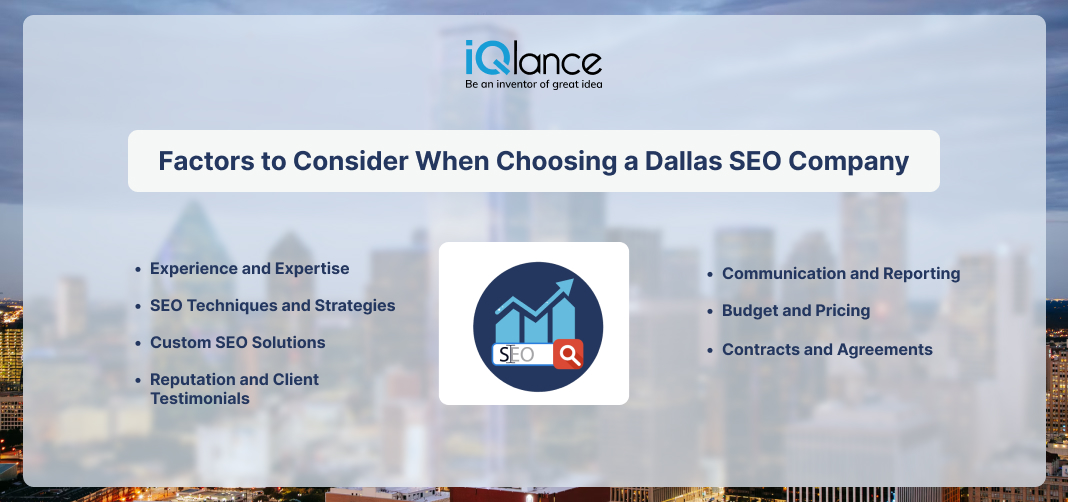
3. Factors to Consider When Choosing a Dallas SEO Company

factors-to-consider-when-choosing-dallas-seo-company

When you’re looking for the right Dallas SEO company, here are some important things to think about:

1) Experience and Expertise:

Look for an agency that has been around for a while and has helped businesses like yours.

  • Track Record: Ask to see examples of their past work. A good agency will have success stories and happy clients.
  • Industry Knowledge: Make sure they know your industry. Different businesses need different SEO strategies.
  • Technical Skills: They should be skilled at using SEO tools to help improve your website.

2) SEO Techniques and Strategies:

Not all SEO techniques are the same. Be careful of agencies that use shady tactics that could hurt your website in the long run.

  • Good Practices: Make sure they follow ethical methods called “white-hat SEO.” These are safe and effective for long-term success.
  • Content Creation: They should focus on creating high-quality content and using the right keywords to help people find your business.
  • Open Communication: They should clearly explain their strategies and what you can expect.

3) Custom SEO Solutions:

Every business is unique, so your SEO strategy should be too.

  • Tailored Plans: Look for a company that creates a customized SEO plan just for you, rather than using a one-size-fits-all approach.
  • Flexibility: As your business grows, your SEO needs might change. Choose a partner who can adjust their services to help you.

4) Reputation and Client Testimonials:

Before you hire an agency, check what other people say about them.

  • Client Reviews: Look for reviews online or ask for references. You want to see positive feedback from their past clients.
  • Case Studies: Ask for examples of how they helped other businesses succeed.

5) Communication and Reporting:

Good communication is key. You want to know what’s happening with your SEO campaign.

  • Regular Updates: Make sure the agency provides updates on your website’s progress and performance.
  • Clear Reporting: They should share easy-to-understand reports showing how your SEO is doing.

6) Budget and Pricing:

SEO can be costly, so it’s important to find a service that fits your budget.

  • Pricing Models: Ask about their pricing options. Some charge monthly fees, while others might charge by the project.
  • Value Over Cost: Remember that the cheapest option isn’t always the best. Look for a company that provides good value for your investment.

7) Contracts and Agreements:

Before you sign anything, understand what you’re agreeing to.

  • Service Agreements: Make sure you know what services they will provide and when.
  • Exit Options: Check if there are ways to cancel the contract if you need to.

4. Questions to Ask a Potential SEO Partner

Here are some important questions to ask when meeting with an SEO agency:

  • How do you keep up with SEO trends?
  • What’s your process for doing SEO audits?
  • Can you share success stories from businesses like mine?
  • What tools do you use to measure SEO success?
  • How do you handle local SEO for businesses in Dallas?

These questions can help you find the right partner for your business.

5. Red Flags to Watch Out For

Not all SEO companies are trustworthy. Here are some signs that you should be careful:

  • Guaranteed Results: If an agency promises to get you to the top of Google quickly, be cautious. SEO takes time, and no one can guarantee rankings.
  • Lack of Transparency: If they are not clear about their methods, that’s a warning sign.
  • No Proven Success: If they can’t show you real results from their past clients, you might want to look elsewhere.

6. Final Steps Before You Decide

Before you choose an SEO company in Dallas,TX, take these final steps:

  • Compare Options: Look at different agencies and their services.
  • Test Their Communication: See how quickly they respond to your questions and how clearly they explain things.
  • Set Goals Together: Make sure you both agree on what success looks like before you start working together.

Conclusion

To choose the best Dallas SEO company, consider their experience, reputation, and understanding of local SEO. Evaluate their techniques, ask for case studies, and ensure clear communication. Look for personalized, ethical strategies tailored to your business needs.

Are you ready to see real results for your business? Contact iQlance, a trusted Dallas SEO company that has helped many small businesses grow. Let’s talk about how we can improve your online presence together. Please call us at (+1) 469-398-8817 for a free consultation.

Posted in SEO

Why Startups and Enterprises Need Fintech App Development?

Why Startups and Enterprises Need Fintech App Development?

The financial services sector is currently experiencing a continuous revolution due to fintech, and companies of all types are busy adapting to these changes. Companies that specialise in the development of financial technology solutions are responding to the increasing demand for applications that prioritise safety, efficiency, and scalability. Individuals such as iQance Solutions concentrate on the development and enhancement of financial technology solutions to assist businesses in maintaining robust security measures, optimising their financial processes, and enhancing consumer experiences. The following text investigates the benefits, limitations, and abilities of fintech application development. The investigation examines the innovative concepts that a reputable organisation such as iQlance Solutions provides to both businesses and individuals.

What is a Fintech App Development Firm & Its Role?

Startups specialising in the creation of fintech applications—which are meant to improve financial processes by means of digital solutions—make up the software development industry. Companies like these are vital in the creation of apps using state-of-the-art technologies such as blockchain, artificial intelligence, and cloud computing to guarantee safe transactions, monitor financial processes, and provide perceptive data analytics.

The legal responsibilities of an entity that produces financial apps go beyond the code manufacturing. Their wide range of offerings includes consultation, design, implementation, and deployment as well as strategy formulation. There are also many other offerings available. These companies make sure the software regularly satisfies financial responsibilities, upholds strict security standards, and offers the required scalability for the development of the company.

Leading mobile App Development Company iQlance Solutions has evolved into the go-to option for both startup companies looking for creative and tailored financial solutions as well as existing companies. Innovative, safe, and effective financial solutions are created in great part by companies which specialise in the development of financial technology applications. This is true independent of the simplicity of the payment system or the complexity of the blockchain solution of a corporation. 

Key Benefits of Hiring a Fintech App Development Firm

Businesses can improve their operations and services by taking advantage of the many benefits provided by fintech app development companies. There are several reasons why you should employ a reputable organisation like iQlance.

  1. Enhanced Security Features

As financial information is so sensitive, a compromise of this kind might result in massive damage. Fintech app development businesses emphasise security by using advanced security techniques such as two-factor authentication, encryption, and others to safeguard users’ financial data.

  1. Automation of Financial Processes

Payment processing, invoicing, and account management are just a few examples of tedious financial tasks that fintech software might help with. This allows organisations to save time and limit the possibility of human mistake.

  1. Real-time Data Analytics

Businesses can make more informed choices by using fintech solutions that give real-time access to financial data. This might lead to improved cash flow management, more effective operations, and more satisfied consumers.

  1. Regulatory Compliance

Money-related apps must comply with a variety of local and international rules. Businesses that specialise in designing fintech applications have a thorough grasp of these criteria and ensure that their solutions comply with all relevant regulations.

  1. Scalability

Businesses’ financial needs alter as they expand. A fintech app development company Dallas validates the program’s scalability and capacity to handle increasing user traffic or transactions without losing performance.

How Are Fintech Applications Developed?

Handling the difficult and sometimes demanding journey of establishing a fintech application requires a clear, forward-looking attitude combined with specialist expertise. Companies like iQlance use a range of tactics when fintech apps are developed:

  • Ideation & Conceptualization

The first part consists of identifying the personal goals, background, and needs. This stage consists of the layout and concept of the features, usability, and design of the application.

  • UI/UX Design

Fintech apps give user experience top priority as users’ faith in the financial powers of the app is so important. Right now, the design team is mostly focused on building an intuitive user interface that supports flawless interaction.

  • Development

The frontend and backend of the program have been built to some degree. iQrance develops safe and effective apps using modern technologies such artificial intelligence, blockchain, machine learning, and cloud computing.

  • Testing & Quality Assurance

After the software is developed, it is thoroughly tested to ensure that no security flaws or vulnerabilities exist. This covers all three evaluation categories—functional, performance, and security.

  • Deployment & Maintenance

Once testing ends, the software will be available on the assigned platforms—Android, iOS, and the web. iQlance is committed to provide ongoing maintenance and assistance to ensure that the software stays safe and current after installation.

Categories of Fintech Apps

Different kinds of financial services, each fulfilling a unique function, include personal money administration, institutional transactions, and peer-to-peer services. Fintech applications provide a wide range of financial services, each of which is distinctive in its own right. The following are a few of the most frequently encountered types:

  • Payment Apps

These apps enable users to make payments digitally, both for individuals and businesses. Popular examples include PayPal and Venmo.

  • Insurance Apps

Insurance fintech apps help users purchase, manage, and claim insurance policies through digital platforms. These apps simplify the process of filing claims and managing policies.

  • Lending Apps

Lending apps connect borrowers and lenders, allowing users to apply for loans or provide peer-to-peer lending services. Apps like Lending Club fall into this category.

  • Wealth Management Apps

These apps help users manage their investments, track portfolio performance, and make informed financial decisions. Examples include apps like Robinhood or Wealth front.

Technologies Used in Fintech App Development

To create powerful, secure, and efficient fintech applications, developers use a combination of advanced technologies:

  • Artificial Intelligence (AI)

AI is used for automating processes, detecting fraudulent activities, and providing personalized financial recommendations.

  • Blockchain

Blockchain technology ensures transparent and secure transactions, making it particularly useful for applications involving cryptocurrencies or complex financial contracts.

  • Cloud Computing

Cloud platforms provide scalability and flexibility, allowing fintech apps to handle large volumes of data and transactions efficiently.

Fintech App Development Cost Estimates by Type

The cost of fintech Mobile app development depends on several factors, including the complexity of the app, the features required, and the technologies used. Here are some general estimates based on app type:

a. Simple Payment Apps

  • Cost: $30,000 – $50,000
  • Timeline: 3-6 months

b. Insurance Apps

  • Cost: $50,000 – $100,000
  • Timeline: 6-12 months

c. Lending Apps

  • Cost: $70,000 – $150,000
  • Timeline: 9-12 months

d. Blockchain-Based Apps

  • Cost: $100,000 – $200,000+
  • Timeline: 12+ months

The cost also varies depending on factors such as the geographical location of the development team and the specific features needed, such as AI integration or multi-currency support.

Challenges in Fintech App Development

Developing fintech apps comes with unique challenges, including:

  • Regulatory Compliance

Compliance with financial regulations, such as GDPR, PSD2, and KYC/AML laws, is mandatory. Ensuring that the app meets all these legal standards requires careful planning and implementation.

  • Security Concerns

Financial data is highly sensitive, making security a top priority. Firms must implement advanced encryption, secure payment gateways, and multi-factor authentication to prevent breaches.

  • Integration with Existing Systems

Many businesses already have established financial systems. Integrating new fintech applications with these systems can be a complex task.

  • Data Privacy

Ensuring data privacy, especially when dealing with personal financial information, is crucial. The app must follow strict data protection standards.

How to Choose the Right Fintech App Development Firm

Selecting the right fintech Mobile App Development Company Dallas is essential for the success of your project. Here are key factors to consider:

  1. Experience in the Industry

Look for firms with a proven track record in fintech app development. Firms like iQlance have extensive experience working with both startups and enterprises.

  1. Technology Stack

Ensure that the firm uses modern technologies, including AI, blockchain, and cloud computing, to develop secure and scalable apps.

  1. Client Reviews and Case Studies

Check reviews, testimonials, and case studies to evaluate the firm’s capabilities.

  1. Cost and Timeline

Discuss the project’s cost and timeline upfront to ensure they align with your budget and expectations.

Why Choose iQlance as Your Fintech App Development Partner?

iQlance stands out as a leading fintech app development company Dallas due to its focus on innovation, security, and scalability. Here’s why you should consider iQlance for your next fintech project:

  • Expertise Across Multiple Fintech Domains

iQlance has extensive experience in developing fintech apps for payment processing, lending, insurance, and wealth management.

  • Cutting-Edge Technologies

iQlance leverages the latest technologies, such as AI, blockchain, and cloud computing, to build future-proof fintech solutions.

  • Security and Compliance

iQlance ensures that all fintech apps meet the highest security standards and comply with regulatory requirements.

  • Proven Track Record

With numerous successful projects, iQlance has earned a reputation for delivering top-tier fintech apps for both startups and enterprises.

Fintech App Development Case Studies

  • Payment Processing App for a Startup

iQlance developed a user-friendly, secure payment processing app that allowed users to make instant payments. The app integrated multiple payment gateways and featured advanced security protocols.

  • Blockchain-Based Lending Platform for an Enterprise

For a leading financial institution, iQlance created a blockchain-based lending platform. The platform enabled peer-to-peer lending with transparent, tamper-proof transactions, resulting in faster and more secure loans.

The future of fintech app development looks promising, with trends such as:

  • Decentralized Finance (DeFi)

DeFi apps, powered by blockchain, enable financial transactions without intermediaries, providing faster, cheaper, and more secure services.

  • AI-Powered Financial Advisors

AI-driven fintech apps will continue to offer personalized financial advice and automate complex financial decisions.

  • Enhanced Cybersecurity

As financial crimes evolve, fintech apps will integrate more advanced cybersecurity measures to protect users.

How iQlance Provides Solutions for Startups vs. Enterprises

  • Solutions for Startups

iQlance offers tailored fintech app development solutions for startups, focusing on cost-effectiveness, speed to market, and scalability.

  • Solutions for Enterprises

For enterprises, iQlance provides advanced fintech solutions with complex functionalities, security compliance, and the ability to handle high transaction volumes.

Conclusion

Fintech app development is a critical investment for both startups and enterprises seeking to streamline financial services, enhance customer experiences, and stay ahead of the competition. A reliable fintech app development firm like iQlance Solutions can provide tailored solutions that meet your specific business needs. With expertise in the latest technologies and a focus on security and scalability, iQlance ensures that your fintech app is not only efficient but also future-proof.

If you’re looking to develop a fintech app for your business, whether you’re a startup or an established enterprise, iQlance offers the expertise, innovation, and security needed to make your project a success. Let’s discuss how we can make your project a success!

Frequently Asked Questions (FAQs)

Q1. What technologies are used in fintech app development?

Fintech apps commonly use AI, blockchain, and cloud computing to enhance functionality, security, and scalability.

Q2. How long does it take to develop a fintech app?

The development timeline depends on the app’s complexity. Simple apps can take 3-6 months, while more complex apps may take 9-12 months or longer.

Q3. Why is security important in fintech apps?

Security is critical in fintech apps to protect sensitive financial data and prevent fraud. Security measures like encryption, two-factor authentication, and secure payment gateways are essential.

Q4. What are the common challenges in fintech app development?

Common challenges include regulatory compliance, security concerns, integration with existing systems, and ensuring data privacy.

Q5. How much does it cost to develop a fintech app?

The cost of fintech app development varies based on the type and complexity of the app. Simple apps can cost around $30,000, while more complex ones can exceed $100,000.

Q6. Why choose iQlance for fintech app development?

iQlance offers expertise in fintech app development, uses the latest technologies, and has a proven track record of delivering secure and scalable apps for both startups and enterprises.

Order Management Software: Key Features & Benefits

Order Management Software

Order management software is also known as Order Management System abbreviated as OMS which is a system that deals with the order processing system for all kinds of industries from Logistic Software Development Company to Healthcare Software Development. It monitors every aspect of the order cycle including order entry, order receipt, storage, processing and order delivery and even after delivery. This means that through OMS, doing things in the correct way  can be successful, customers’ satisfaction can be increased, and the overall organizational performance can be improved.

Why is Order Management Software Important?

OMS is very important in any organization that is involved in the selling of goods and products especially those that involve the distribution channel. Here are a few reasons why:

  • Efficiency: Streamlines the time consuming routine activities related to order management thus reducing the time spent by the workers.
  • Real-Time Tracking: Enhances update status on order delivery to enable firms deliver on customer expectations regarding order delivery time.
  • Reduced Errors: Reduce exposure to human input errors through automation of various processes in the organization, and consolidation of order data.
  • Improved Customer Experience: Makes sure that the customers are informed throughout the whole process of placing an order which boosts trust and loyalty.
  • Scalability: OMS also has the capabilities of expanding as the business establishes itself and moves to the next level of handling many orders as it did in the beginning.

Key Features of Order Management Software

When developing an Order Management Software, it’s essential to include the following features to ensure smooth operation and superior user experience:

  • Order Processing

OMS automates the entire order workflow, from order capture to fulfillment. It consolidates orders from multiple sales channels, processes them efficiently, and directs them to the appropriate warehouses or distribution centers.

  • Inventory Management

Integrating inventory management ensures that stock levels are automatically updated as orders come in and go out. This helps businesses avoid overstocking or stock outs, making the order process more efficient.

  • Multi-Channel Order Integration

OMS should integrate with all sales channels (e.g., From e-commerce platforms, Logistic Software Development Company to Healthcare Software Development, marketplaces, physical stores). This integration ensures that orders from different sources are consolidated into a single system, simplifying management.

  • Shipping and Fulfillment

OMS should connect with various shipping providers, automating the shipping process. From calculating shipping costs to tracking deliveries, a seamless connection between OMS and shipping providers is vital for accurate and timely order fulfillment.

  • Customer Management

OMS must include features for tracking customer data, enabling personalized communication, and ensuring that customer inquiries about orders are addressed promptly. It should allow businesses to store customer order history and preferences for future engagement.

  • Returns and Refunds

The ability to handle returns and refunds smoothly is critical to customer satisfaction. OMS should automate the return process and manage refund requests efficiently, ensuring a hassle-free experience for customers.

  • Reporting and Analytics

OMS must provide detailed insights into order performance, customer behavior, sales trends, and more. These reports are crucial for making data-driven decisions and optimizing the order management process.

  •  Scalability

As your business grows, your OMS should be able to handle more transactions, users, and products without a decrease in performance. Scalability is an essential feature to consider during the development process.

The Development Process of Order Management Software

The Development Process of Order Management Software

Order Management software are complex and should be developed systematically. Below are the key steps involved in the process:

1. Understanding Business Needs

The first of these steps is to establish the needs that are unique to the given business. In this step, you have to review the existing order management processes, including operations’ problems, and identify requirements that the OMS should meet. Specifically, they have to find out which options are indispensable for the enterprise and how the proposed system should interact with the employed applications, such as CRM or ERP.

2. Choosing the Right Development Approach

There are two primary development approaches for OMS:

  • Custom Development: This enables business organizations to develop a software that suits all of its requirements. This option gives the most flexibility because you can achieve any functionality that you wish, but it entails a lot of time, as well as financial resources.
  • Pre-Built Solutions with Customization: It is also possible to choose already built OMS platforms which are made up of extensible modules. These platforms arrive equipped with standard features which can be customized for different businesses, making development less time consuming and costly.

3. Choosing the Technology Stack

Choosing the right technology is of great importance in determining the capability, expansion and adaptability of the OMS. Java, Python and. languages are used in programming for OMS. NET. It is recommended to name the priorities of the technology stack as integration with current systems, possibility of multi-channel scheme, and real-time characteristics.

  • Front-End Development: Frameworks such as Facebook’s React, Google’s Angular, or the/JavaScript framework Vue. js could be employed in the creation of a user friendly interface of the OMS dashboard.
  • Back-End Development: Backend can be created using Node. js, Django (Python), or Spring (Java) with the best practices of Security to process the orders effectively and efficiently.
  • Database Management: MySQL database or PostgreSQL or MongoDB is required to store and manage the order data for a large number of orders.

4. Integrating with Third-Party Services

OMS needs to integrate seamlessly with other business systems, such as:

  • Inventory Management Systems: To provide real time information concerning the available stock.
  • CRM Platforms: To manage customer information and for the purpose of communicating with the customers better.
  • Payment Gateways: To facilitate the operations that involve making and completing different kinds of purchases and payment.
  • Shipping Providers: In order to optimize the work of shipping and contribute to the delivery tracking.

5. Security Measures

Due to the fact that orders and customers’ information are rather paramount, it is mandatory to apply safety protocols. This includes:

  • Data Encryption: Makes certain that some form of delicate information- for instance- payment details- is safely relayed.
  • Role-Based Access Control (RBAC): This makes it possible to restrict the use of some items to only specific personnel in an organization.
  • Data Backup and Recovery: Sharing should be allowed though copies of the data should be taken frequently so that in case of loss or any damage it can be restored.

A major disadvantage of this system is the possibility of loss in the event of system failure.

6. Development and Testing

This is followed by putting up the remaining structures of the system as followed by the actual development. Developers are responsible for creating the front end and the back end plus integrating the databases and making sure that they are communicating well.

Thus testing is an integral process in software development life cycle. Then integration testing verifies the compatibility of the software between different levels, and the user acceptance testing (UAT) verifies that the software responds as intended to all possible cases.

7. Deployment and Implementation

That is when the Order Management Software or OMS as it is commonly known is prepared for a deployment after undergoing very intense tests. At this stadium the software is being used in the business setting with all the integration such as inventory and shipping in operation.

8. Training and Support

The last step is education of the employees on how to work with the newly implemented OMS. Since the training is done practically, it is advisable to offer detailed documentation for use and at the same time, it is advised to conduct training sessions so that the employees get used to the new system. Further, it demands constant technical support to solve problems that may occur throughout the day to day usage.

Benefits of Developing Custom Order Management Software

Investing in a custom-built Order Management Software offers several advantages:

  • The Offers a Solution to Suit Your Business

An OMS that is designed to suit the need of your business is designed. Compared to the standard solutions, a custom solution can take into account the specific aspects, which are vital to your organization, and thus, have better integration with your workflow.

  • Increased Efficiency

Some companies opt for developing a custom-built OMS that enables organizations to undertake manual tasks which were time-consuming and used many resources hence enhancing order cycle time. Automation eliminates margin of errors and hastens completion of several procedures.

  • Enhanced Customer Satisfaction

Combining the real-time shipment tracking and smooth order updating, the customized OMS can provide customers with better experience and satisfactory feedback during the entire process of order. This also allows customization of communication to customers in a way that also facilitates notification or update on events.

  • Competitive Advantage

An OMS developed for your business such as agricultural business can act as a strategic weapon. It can serve as a means to better organize your work processes, enhance the relationship with customers and increase your performance more actively than other businesses utilizing non-tailored tools.

  • Scalability

Over time your sales would increase and so would the number of orders that you need to fulfill. Such systems are basically built with integration options meaning that an organization can obtain a one of its kind OMS which the Software Development Company can scale up; meaning that there is no need to reinvest and replace most or all of the OMS later on.

Challenges in Developing Order Management Software

While developing a custom Order Management Software offers numerous benefits, there are also challenges to be mindful of:

  • High Development Costs

Custom software development normally entails high initial costs that may be quite burdensome. Nevertheless, there are potential risks when it comes to such integration in the long run. These are improved operating efficiency and customer satisfaction which are likely to overshadow all the costs in the long run.

  • Time-Consuming Process

Outside building a custom OMS from the ground up, it is quite time consuming considering the time taken in development, testing, and enriching employee’s skills for using the system’s end product. However, the amount of time spent on the development of the program pays off in terms of a system that meets the client’s needs to the last detail.

  • Integration Complexities

Probably the biggest difficulty of OMS is its ability to connect with legacy systems like inventory, shipping, and payment gateways, among others. Those complexities can be managed by selecting the right development team and applying modern technology stack.

Keeping up with the most current developments in the order management system (OMS) can help companies keep ahead of the competition:

  • Artificial Intelligence and Machine Learning

Using artificial intelligence and machine learning is changing the way orders are handled and handled. All of which improve general efficiency are the automated repetitious chores, inventory level management, demand forecast made possible by technological advancement.

  • Cloud-Based OMS

Commercial businesses are progressively using cloud-based order management systems more and more. By using cloud solutions, companies may gain from scalability, remote access, and flexibility, thus simplifying order management anywhere.

  • Mobile OMS

Organisations are using user-friendly OMS systems that are easily navigable on mobile devices as mobile commerce picks steam. Mobile order management systems (OMS) let staff members effectively handle orders, maintain inventory, and check delivery status straight from their cell phones, therefore enabling smooth order processing while on the go.

  • Omni-Channel Order Management

Whether they are investing while on the go, browsing in-store, or interacting online, the modern consumer searches for a flawless and easy purchase path across every platform. By using a thorough order management system, companies may improve the efficiency of their order processing and raise the customer service across many platforms. 

Choosing the Right Order Management Software Development Company

Structures for overseeing manufacturing orders Software development is a complex activity requiring a lot of resources and a team of capable people working together. Choosing a development partnership calls for careful evaluation of many important criteria:

  • Experience and Expertise

Enquire with the development team about their comprehension of the specific obstacles your organisation is currently facing and whether they have any prior experience with order management systems.

  • The System of Technical Support

It is recommended that the development team choose a modern technological framework that enables seamless integration with other systems, scalability, and flexibility.

  • Support following development

It is imperative that your development partner provide continuous support and maintenance to ensure that the software remains functional and adapts to the expansion of your company.

  • Comments and Testimonials from Clients

The effectiveness of prior initiatives can be evaluated by examining case studies and soliciting feedback from clients. It is essential for a potential development partner to have a history of successfully integrating OMS with other systems.

Conclusion

Through improved operational efficiency, mistake reduction, and raised customer satisfaction levels, order management software may significantly affect companies. Using a customised OMS will let you modify the program to fit the particular requirements of your company, therefore guaranteeing its scalability and flexibility as your company develops.

Organizations must incorporate emerging technologies such artificial intelligence (AI), mobile operations management systems (OMS), and cloud-based solutions if they are to keep a competitive advantage in the environment of today. There are more examples of cloud-based systems. Important considerations are the use of a contemporary technical framework, the deliberate strategizing of your Order Management Software installation, and the selection of the suitable development partner.

When implementing an OMS, consider factors such as using a modern technology stack, carefully planning your OMS deployment, and choosing the right development partner. iQlance Solutions, a leading order management software development company, specializes in creating tailored solutions for various industries, including logistics and healthcare.

By investing in a customized OMS, you’re not just purchasing software; you’re making a strategic decision that safeguards your business from risks and ensures its continued success in a highly competitive environment.

Custom Software Development Cost in 2025: A Complete Guide

As organisations ventured deeper and as they engaged into transformation to be able to sustain themselves in the new world without face to face encounter, it can be said that the need for application software solutions have become more demanded in recent years. Frankly speaking, irrespective of the nature of your organization whether you are a new generation startup based in Dallas or a big shot giant organization seated in Houston, it is in your best interest to be abreast with all the costs that are associated with custom software development so that you take informed decision based on your business needs and requirements.

Most of the time, clients enquire about estimated cost for custom software development and relevant cost drivers. Today we are considered one of the most reputable software development companies in both Dallas and Houston areas with the experience and skills to deliver only the best to our clients. Today, we will look into these factors that define the cost of a software in the year 2025 and tips that will help you in preparing and allocating your budget in the right way so as to maximize your Return of Investment.

Introduction to Custom Software Development

Custom software development in other words, can be defined as the steps of designing, implementing, installing and sustaining of system that will work independently for an individual business or organisation. While there are ready-market software solutions, which are general solutions applicable in your organisation despite the existing difficulties, custom software is developed with your needs in mind. This way, all the features of the software are used to support the business processes, increase efficiency and become an advantage over competitors in a particular industry.

Advantages of Custom Software Development:

  • Personalization: Custom software is developed based on your requirements, which mean that all aspects of the software are customised to fit your organisation’s requirement.
  • Scalability: Custom systems are also flexible, meaning that they can change according to the business requirements as it grows and custom software rarely needs to be updated, revamped or reinvested in new systems.
  • Integration: Another benefit of custom software is that you will be able to use it as an addition to your existing systems and processes and it will not disrupt production very much.
  • Security: Customizations in solutions provide improved security features due to their insulation from original threats since they are deployed in the business environment of the implementing organisation.

However, these advantages are accompanied by a number of costs based on the following considerations. Understanding of these facets is necessary when drawing inference about the processes of software development projects customization.

Custom Software Development Cost Estimation based on various factors

That’s why the cost of custom software development in 2025 can be affected by a lot of factors. They point to some extent to provide evaluation of the potential funding and decision-making concerning the financing in the future for the businesses in Dallas, Houston and other cities.

1. Project Scope and Complexity

In fact, the scope of the project is one of the critical drivers of the cost of custom software development, in that it determines the size of work that needs to be done and the amount of effort required in relation to the various tasks and activities that make up a project. The level of intricacy in a software determines the resources it will use in its functioning hence the cost.

  • Simple Projects: Such are the ones that are basic either in the mobile application tier or in the web application tier and are not congested with too many or different variations of features and functionalities. These kinds of projects tend to cost between $20 000 and $50 000.
  • Moderately Complex Projects: For applications that are going to need features like user authorization, payment integration or third-party API integration, costs would range from $50,000 to $100,000.
  • Highly Complex Projects: The solutions, which can be developed for enterprise level and include such features as AI, machine learning, or big data processing, can easily start from $100 000.

The size of a project is also considered from different aspects including the number of features, level of customization, and integration with other systems.

2. Development Team Expertise and Location

Obviously, the cost to develop an application is influenced by the skills possessed by the development team and where they are located. Though it may be cheaper to outsource software development services to a team in another country located in Asia, hiring a company in Dallas or Houston will have its benefits including better communication, enhanced cultural fit and understanding of the market there.

  • Local Development Teams (USA): Usually cost between $150 to $250 per hour.
  • Nearshore Development Teams (Latin America): Bill between $50 and $150 per hour or slightly higher, but not more than $200 per hour because though expensive these services are more professional.
  • Offshore Development Teams (Asia, Eastern Europe): Technicians are usually paid anything within $30 to $100 per hour- making this an affordable way to get professional help- though the relationship tends to come paired with possible issues in communication and overlapping working hours.

At iQlance Solutions, we follow an intelligent model where we have localized teams from Texas, both in Dallas and Houston and offshore resources that cater to cost efficiencies. It lets us provide sophisticated software solutions at reasonably lower costs while ensuring that our communication and project organization meet our clients’ expectations.

3. Technology Stack

However, the cost of developing an application can vary a lot depending on the technology stack selected during your project. Each technology has its own degree of sophistication, amount of demand and usage on resources and ultimately, the costs. Some of the most common technology stacks include:

  • Front-End Technologies: React, Angular, Vue.js
  • Back-End Technologies: Node.js, Python, Java, .NET
  • Database Technologies: MySQL, PostgreSQL, MongoDB
  • Mobile Development: Swift (iOS), Kotlin (Android), Dart (Flutter Cross-Platform)

As with any piece of software, the technology stack must be chosen depending on the actual characteristics of the project, the necessary and sufficient functionalities, extensibility, and, in general, the maintainability of the project. Technologies that may be considered specialized or for which the involvement of experts in their development is more likely to be expected will, in most cases, translate to higher costs of development.

4. Development Methodology

The choice of the development methodology that you adopt can have an impact both on the time it will take and how much you spend. It is also important to note that agile methodologies are often more costly and less stable than other approaches, but leads to a better design and implementation of what you actually need for your business.

  • Agile Development: It is generally more costly because of the back-and-forth process, but it is more agile and even more effective most of the time than the final output.
  • Waterfall Development: Sometimes cheaper initially, but overall tends to be more costly when great alterations are required part way through a project because of its inflexibility.

Selecting the right development methodology is based on the project, development timeline, and how engaged you want to be in the development phase. At iQlance Solutions, we find that Agile development is very suitable for most of the custom software development projects since everyone has a chance to address any issue they discover as the work progresses.

5. Post Launch Support and Maintenance

It’s important that once you have a custom software solution you should have to take support and maintenance services to make the software working, secure, and updated. This encompasses features such as updates, when developers find some technical issues with your applications, solving them and expanding based on your business’s growth. The post-launch support is usually a percentage of the first development cost, and is usually between 15% to 25% annually.

  • Basic Maintenance: Mainly comprise the modification features and fixing of some existing glitches and tend to be about 15% of the initial development cost annually.
  • Comprehensive Maintenance: This involves maintenance, upgrade and making the application fit for expanded usage and is usually charged at 15–25% of the initial cost of development per year.

As such at IQlance Solutions a leading Software development Company Houston we come up with affordable and flexible maintenance plans depending on the unique needs of your business to ensure that your software meets the maximum efficiency after it has been implemented.

Estimating Custom Software Development Costs in 2025

Based on these factors it is strongly recommended to have a clear understanding of your requirements and how much you want to spend on the development of custom software. Further, we present below a rough guideline that gives an idea about the expenses of various kinds of custom software projects.

Small Businesses and Startups

In the case of small businesses and startups, the process of custom software development usually implies the development of a mobile application or a basic web application that can solve a particular business problem. The approximate cost today for such projects often falls between $20, 000 – $50, 000.

  • Example: While a large restaurant chain in New York might only need an app to both order online and track deliveries, a single restaurant in Dallas may have a very different case.
  • Key Cost Drivers: Creating web interface, connecting to the payment systems, creating the most necessary administrative tools, and implementing log-in for identification.

Another advantage of building a MVP is that startups get to launch the mere minimal software but with its requirements. An MVP can be developed at a cheaper price range of $10,000 -$30,000 that would help the startup see the market and feedback from the users before going in for enhanced features.

Medium-Sized Businesses

Small businesses have simple needs; therefore, they can do with simple applications like an Ms. Excel, Ms. Word, or email software while medium businesses have the need for more complex software such as a custom built Customer Relationship Management (CRM) system, an Enterprise Resource Planning (ERP) system, and or an eCommerce platform. In most cases, the cost of such projects falls between $50, 000 and $150, 000.

  • Example: A retail company in Houston may require the development of an exclusive e-commerce solution equipped with the inventory control system, an analysis of client’s data, and synchronization with their current POS systems.
  • Key Cost Drivers: Different types of users, rich functionality of reports, opportunity to integrate with other services and products, and the ability to expand the system.

It is more likely that these kinds of projects need integration with current business processes, resulting in a higher cost. Nevertheless, it is often argued that it is a necessary one due to the enhanced productivity, beneficial changes to customers’ experience, as well as the data handling of the software.

Enterprise-Level Businesses

Such clients deal with enterprise level businesses that demand a greatly enhanced and highly complementary software solution that is compatible with their business’ existing system and structure. It is usually expensive, with project costs reaching over $150 000 and subsequent phases for the continual enhancement of the software to meet the needs of the business.

  • Example: A manufacturing company in Dallas may need a system that can address client’s specific needs such as integrated IoT, real-time data processing, and advanced analytical engine.
  • Key Cost Drivers: Rich functionalities, high degree of customization, multiple user personas, multiple system interface, and high security concerns.

They are typically complex, long-term initiatives which take many months and entail coordination between the development and the business sides. It means creating an effective software solution for today’s business operations, decision making, and achieving a competitive edge.

Why Choose iQlance Solutions for Custom Software Development?

At iQlance Solutions, we understand that every business is unique, and so are its software needs. As a leading software development company in Dallas and Houston, we are committed to delivering high-quality, custom software solutions that drive business success. Here’s why businesses Hire Software Developers from iQlance Solutions for their custom software development projects:

  • Extensive Industry Expertise

As experts in healthcare, finance, retail, manufacturing sectors etc., our team has the ability to identify and address your business concerns, efficiently. This knowledge we apply to provide you with not only operational, but also tactical software solutions for your business requirements.

  • Hybrid Development Model

The proposed development model is a pack of the strength of our local developers based in both Dallas and Houston and the benefits of the offshore model. This approach allows us to offer our clients the best of both worlds: that reflects high-quality standards of the local development and the cultural appeal of development towards the cheap offer made by offshore development.

  • Customer-Centric Approach

Our client-clerk relationships at iQlance Solutions are long term in nature and we follow a different technique. Through our customer-oriented management, it is always possible to adjust to the needs of the client. We offer continuous reporting at different stages of the development process, and we remain accessible to answer your questions after the product launch and to work on making the software fruitful for you and your business.

  • Cutting-Edge Technology

To this end, we ensure that we embrace current technologies and development practices in the market. It may be AI or Machine Learning or IoT or Blockchain or Cloud Computing, we make certain that your software is being developed using the best across the industry tools available in the market. This commitment to innovation guarantees that the software you’re provided is not only contemporary but also, ahead of these trends, a plus for the growth of your business.

  • Agile Development Methodology

To avoid late delivery of your software and uncontrolled expenses, we stick to Agile development processes for adjusting to your requirements’ dynamics. This approach enables a modification process during development so as to achieve the end product that will meet your expectations as well as the intended outcomes of the development process.

Conclusion: Planning Your Custom Software Development Project

To conclude, Hire Dedicated Software Developers,  or  custom software development team  is a large investment that will influence the prospects of your enterprise. When knowing the factors that determine cost and engaging the right partner such as iQlance Solutions, the required investment can be attained.

No matter your location within Texas – Dallas or Houston in particular – you can depend on our team for a personalised approach, from the consultation stage to providing further assistance after the website has been launched. We will listen to your business requirements, design the solution that would fit perfectly to your business needs and objectives, and further help you with the application to make sure that it is useful to you.

It’s time to harness the power of custom software to grow your business, contact us today! Don’t hesitate to contact iQlance Solutions right now to get a free quotation and other necessary information about our services. Let’s turn your vision into reality and propel your business forward to achieving the results you want in 2025 and beyond.

How to Hire A Dedicated Team in India: A Step-by-Step Guide

hire-dedicated-developers-india-guide

Outsourcing to India is one of the most effective ways for businesses to improve productivity, access international talent, and reduce employee costs. India is currently one of the global leaders in IT and business outsourcing, offering professionals skilled in software development, design, digital marketing, and more. This guide provides a detailed breakdown of how to hire a dedicated team in India, from defining project requirements to managing and evaluating the team’s success.

By the end of this blog, you’ll be equipped to hire effectively and take your business forward with the right dedicated team in India.

What is a Dedicated Team?

A dedicated team refers to a group of professionals hired exclusively to work on your project or business requirements. Unlike freelancers or short-term contractors, a dedicated team works long-term as part of your staff. This outsourced team is tightly integrated with your in-house team and works closely to achieve your objectives.

Why Hire Dedicated Team in India?

Cost-Effective Solutions:

India is renowned for providing high-quality professional services at competitive prices. Compared to hiring developers or other professionals in the USA or Western Europe, outsourcing to India can result in significant savings due to the lower cost of living and favorable exchange rates.

Access to Global Talent:

India is home to a large pool of skilled professionals, especially in Software Development, app development, data science, digital marketing, and design. Indian professionals are up-to-date with the latest technologies, making it easy to find the right candidate for your needs.

Flexibility in Scaling Teams:

One of the main advantages of hiring a dedicated team in India is the flexibility it offers. You can easily scale your team up or down depending on changes in your project scope or business expansion needs, making it an ideal solution for companies that require scalable staffing.

Focus on Core Business:

Outsourcing to a dedicated team in India allows your internal team to focus on high-value tasks like strategy development and customer interactions, while the outsourced team handles lower-value or repetitive tasks.

Step 1: Identify Your Project Needs

Before hiring a dedicated team, you must clearly define your project specifications. Understanding your goals and managing the process effectively will help you secure the right talent.

Assess Your Project Requirements:

Break down your project into clear objectives and deliverables:

  • Project Goals: What is the purpose of your project? Are you developing software, designing a website, or launching marketing campaigns?
  • Skills Required: Identify the technical and soft skills needed for your team. For example, if you’re developing a web app, you may need front-end and back-end developers, UI/UX designers, and QA testers.
  • Budget and Timeline: Determine your budget and deadlines. How much are you willing to invest, and when do you expect to complete the project?

Determine Team Size:

The size of your team depends on the complexity of the project. Small projects might require just a few team members, while larger projects may need a team of 10 or more, including developers, project managers, and other personnel.

Select a Hiring Model:

Choose the hiring model that best suits your needs:

  • Full-time: Ideal for long-term projects that require close collaboration.
  • Part-time: Suitable for smaller tasks or projects with less frequent demands.
  • Contractual: Best for one-time projects with specific deliverables and deadlines.

Step 2: Finding Potential Candidates

Once you’ve defined your project requirements, the next step is to find the right collaborators.

Different Hiring Models:

There are several ways to find professionals:

  • Freelancers: Ideal for short-term or narrowly focused projects, though freelancers may lack the commitment of a dedicated team.
  • Agencies: Agencies offer comprehensive services, including development, testing, and project management, making them ideal for large-scale tasks.
  • In-house Teams: Some companies establish their own research and development centers in India. While flexible, this option can be costly.

Researching Indian Companies:

Conduct thorough research to find the right team or company:

  • Online Platforms: Use platforms like Upwork, LinkedIn, Clutch, and GoodFirms to review company profiles, client testimonials, and past projects.
  • Industry Events: Attend technology and outsourcing events, either in-person or online, to meet potential partners and discover their talents.

Shortlisting Candidates:

Create a shortlist of potential candidates based on the following criteria:

  • Experience: Ensure the company or developer has the necessary expertise to meet your requirements.
  • Portfolio: Review past projects to assess the team’s competency and success rate.
  • Reviews and Testimonials: Client feedback can provide insight into the team’s reliability, communication skills, and ability to meet deadlines.

Step 3: Evaluating Potential Candidates

After shortlisting candidates, it’s time to evaluate each application carefully.

Key Evaluation Criteria:

When assessing candidates, consider:

  • Technical Expertise: Ensure the team has the required skills in relevant programming languages, systems, and tools.
  • Communication Skills: Since you’ll be working remotely, effective communication is crucial. Make sure the team is comfortable using tools like Slack, Zoom, or Microsoft Teams.
  • Cultural Fit: While cultural differences can be beneficial, ensure that they don’t become a barrier to collaboration.

Interviews and Skills Assessments:

  • Interviewing Candidates: Engage in in-depth conversations to understand how candidates handle challenges, their problem-solving approaches, and how they align with your project goals.
  • Practical Tests: Assess technical skills by having candidates complete tasks that simulate real-world project conditions.

Reference Checks:

Contact previous clients to learn about the candidate’s work ethic, reliability, and ability to meet deadlines.

Step 4: Negotiating Terms

Once you’ve chosen the best candidates or agencies, it’s time to finalize the terms of your partnership.

Setting Clear Expectations:

Clearly define your expectations regarding:

  • Deliverables: Specify the tasks that need to be completed.
  • Timelines: Set deadlines for each milestone.
  • Communication: Agree on how often you’ll check in and which communication tools will be used.

Payment Structures:

Choose a payment structure that aligns with your budget and project goals:

  • Fixed Price: Ideal for projects with well-defined goals and timelines.
  • Hourly Rate: Suitable for ongoing tasks where the scope may change over time.
  • Retainer Agreements: Best for long-term collaborations with continuous support.

Ensure you have a strong legal framework in place:

  • Non-disclosure Agreements (NDAs): Protect sensitive information.
  • Intellectual Property (IP) Rights: Clearly define IP ownership once the project is completed.
  • Termination Clauses: Outline the conditions for ending the contract if necessary.

Step 5: Onboarding Your Team

Once the contract is signed, begin the onboarding process to ensure the team becomes productive quickly.

Best Practices for Onboarding:

  • Effective Communication Tools: Set up platforms like Slack, Zoom, or Microsoft Teams to facilitate real-time communication.
  • Provide Necessary Resources: Ensure the team has access to all required tools, software, and resources.
  • Role Definition: Clearly outline each team member’s role and responsibilities to avoid confusion.

Creating a Collaborative Environment:

Foster teamwork by encouraging open communication and regular feedback sessions. Virtual team-building activities can also help strengthen the relationship between your in-house and dedicated teams.

Sharing Your Company Culture:

Introduce your team to your company’s mission, values, and vision. This helps align their efforts with your long-term business strategy.

Step 6: Managing Your Dedicated Team

Effective management is essential for ongoing success. Maintain regular communication, set clear goals, and offer support.

Communication Strategies:

  • Regular Check-ins: Schedule weekly or bi-weekly meetings to review progress and address challenges.
  • Use Project Management Tools: Tools like Asana, Trello, Jira, and Monday.com help track progress and manage tasks.

Setting Performance Metrics:

Establish clear KPIs (Key Performance Indicators) to measure the team’s performance, including:

  • Quality of Deliverables: Are tasks completed to the expected standard?
  • Timeliness: Are deadlines met consistently?
  • Responsiveness: How quickly does the team respond to queries or issues?

Providing Feedback and Support:

Offer regular, constructive feedback and recognize good work. Provide solutions when issues arise to keep the team motivated and on track.

Team Building Activities:

Remote teams benefit from a sense of community. Organize virtual team-building activities or, if possible, occasional in-person meetups to boost morale.

Step 7: Measuring Success and Continuous Improvement

Finally, evaluate the success of your partnership and make adjustments as needed.

Evaluate Performance Regularly:

Monitor the team’s performance to ensure they meet project goals. Hold review meetings at key milestones to assess overall progress and areas that may need improvement.

Key Success Metrics:

Track metrics such as:

  • Work Quality: Are deliverables meeting quality standards?
  • Deadlines: Are project deadlines consistently met?
  • Satisfaction Levels: Gather feedback from both your internal team and the dedicated team to ensure high levels of satisfaction.

Long-Term Relationships:

Building a strong, long-term relationship with your dedicated team can lead to even greater success. Treat them as partners rather than just contractors, and they’ll be more invested in the success of your business.

Conclusion

To hire a dedicated team in India, begin by defining your project needs, including goals, skills, budget, and team size. Research potential candidates or agencies, evaluate them through interviews and tests, and negotiate clear terms. Finally, onboard your team with the necessary resources and manage them effectively using communication and project management tools.

Are you ready to take your business to the next level? It’s time to hire dedicated team in India through iQlance

Contact us today to learn how our skilled professionals can help your business succeed.

FAQs

1. What are the benefits of hiring a dedicated team in India compared to hiring freelancers or in-house staff?

Hiring a dedicated team in India provides focused, long-term commitment to your project, unlike freelancers. It also offers cost-effective solutions compared to in-house staff. Accessing skilled professionals at a lower cost allows businesses to scale efficiently while maintaining quality and expertise without the overhead of full-time hires.

2. How do I ensure effective communication with my dedicated team in India, especially considering time zone differences? 

To manage time zone differences, set clear communication protocols and use tools like Slack and Zoom for real-time discussions. Schedule regular check-ins, and utilize project management tools for asynchronous updates. Clear documentation and flexibility in work hours ensure smooth communication, aligning both teams for successful collaboration across time zones.

3. What is the ideal team size for outsourcing a project to India? 

The ideal team size depends on your project’s complexity. Small projects may require a few key members, while larger projects could need a team of 10 or more. It’s important to scale your team based on project needs, with flexibility to adjust as the project evolves for efficiency and optimal results.

4. How do I manage and measure the performance of a remote dedicated team in India? 

Effective management involves setting clear KPIs, conducting regular check-ins, and using project management tools to track progress. Offer feedback, recognize achievements, and ensure open communication. By monitoring deliverables, deadlines, and team responsiveness, you can effectively manage performance and ensure that goals are being met throughout the project lifecycle.

Ensure you have a solid contract with clear terms on NDAs, intellectual property rights, and termination clauses. Define who owns the IP created during the project, and make sure both parties are aware of legal requirements, including compliance with India’s labor laws and tax regulations to avoid future complications.

Top SaaS App Development Company in Toronto – iQlance Solutions

Software as a Service (SaaS) allows modern companies to run more smoothly. Businesses in many various industries are gradually using Software as a Service (SaaS) solutions. These methods are being used to boost procedures, improve staff collaboration, and provide customers software that is reasonably cost-effective, flexible, and user-friendly. Driven by well-known SaaS App development company iQlance Solutions, this change is the result of It aims to provide companies with modern SaaS solutions that enable their success in a very competitive industry.

Whether you are a small startup trying to upend the market with an exclusive SaaS product or a Fortune 500 company looking to improve its software systems, we are the ideal partner in software as a service (SaaS). With our thorough understanding of the area, superior technical foundation, and dedication to your needs, we develop Software-as- a- Service (SaaS) solutions geared to the specific needs of your company, therefore offering ongoing value. 

Understanding SaaS and Its Impact on Modern Businesses

If you want to understand how software as a service (SaaS) has changed the business world, you need to look into what has made iQlance Solutions a top SaaS development company.

What is SaaS?

“Software as a Service” (SaaS) is the idea that makes use of the internet to provide customers access to managed applications by outside vendors. Accessible to anybody via a web browser, Software as a Service (SaaS) apps are subscription based. This replaces the requirement for people to download and set up programs on their own devices. When compared with traditional programs, this one offers several benefits: 

  • Accessibility:  As you can access it from any internet-connected device, software as a service is a great choice for teams that work from home or have members all over the world.
  • Scalability:  When a company develops, its software as a service (SaaS) programs can easily grow and change to fit more people, services, or data. .
  • Cost-Effectiveness:  When businesses use Software as a Service (SaaS), they can cut down on the original costs of software licensing and setting up equipment. Instead, they have to pay a membership fee that covers all facets of the service, including upkeep and improvements, therefore shielding them from all sides. 
  • Automatic Updates: With supervising updates and maintenance, service providers ensure that their customers have the most current safety improvements and capabilities.
  • Integration Capabilities: The standard procedure is to link software-as-a-service solutions to other cloud-based services and platforms, therefore creating an organised digital setting. 

The SaaS Revolution

The rise of software as a service (SaaS) has changed the operating scene for companies so they may use sophisticated software features free from the constraints and expenses connected with conventional software. Thanks to this change, several sectors have seen fast acceptance of software as a service, also known as SaaS. The industries include finance, education, e-commerce, and healthcare. Using SaaS models helps companies in the fast-paced digital scene of today to keep a competitive advantage, improve customer service, and simplify their processes.

Developing a successful Software-as—a- Service (SaaS) program calls for both technical knowledge and a better awareness of user demands and behaviour. Effective practice depends on an awareness of client demands, industry trends, and security, scalability, and user-friendliness top priorities for development of a solution. iQlance Solutions shows quite mastery in that particular field.

iQlance Solutions: Your Partner in SaaS Application Development

iQlance Solutions understands among other things that every corporate unit has its own goals and difficulties. Being a major player in the field of software as a service (SaaS) app development, our main goal is to provide custom SaaS solutions that meet your particular needs and help you to reach your company goals. Closely working with you, our seasoned team of designers, engineers, and strategists will create creative, adaptable, dependable software as a service (SaaS) solutions that also fit your present and future requirements.

Comprehensive SaaS Development Services

Starting with the first phases of product conceptualisation and ending with post-launch support, our extensive capabilities span the whole software development lifeline. Whether your objective is to develop a new Software-as- a- Service (SaaS) application or improve the features of an existing one, iQlance Solutions can help you to reach your targets.

1. SaaS Application Consultation and Strategy

The most critical factor in the success of any software as a service (SaaS) product is a well-conceived strategy. The iQlance Solutions team will conduct a thorough examination of your company’s demographics, objectives, and competitive environment. A few examples of the consulting services we offer are as follows:

  • Market Analysis: With taking part in industry trends, client demands, and potential competition research, you can ensure that your software as a service is distinguished from others.
  • Requirement Gathering: With being open in group initiatives, you will be able to articulate the qualities, abilities, and general experience that will facilitate the development of your software.
  • Technology Stack Selection: It is imperative that the technologies and frameworks selected align with the project’s objectives and expansion plans.
  • Project Roadmap: The process of developing a complete plan that spans the entire development process, including significant benchmarks, schedules, and measurable outcomes.

2. SaaS Application Design and Prototyping

When it comes to software as a service programs, they can’t do well without great design. A well-designed user interface (UI) and user experience (UX) may dramatically affect customer happiness and acceptance. Our design method consists of the following components:

  • User-Centered Design: Your target audience will appreciate designs that are both aesthetically pleasing and easy to use. 
  • Wireframing and Prototyping: It’s common to make live mockups and wireframes before starting the development process. These help to show the structure and usefulness of the application.
  • Branding and Visual Design: The design ought to include the identity of your business to provide a consistent experience and enable quick identification by consumers. 
  • Responsive Design: It is very important that the program works well on all platforms, including desktop computers, tablets, and phones. 

3. SaaS Application Development

After establishing a solid strategy and design, our development team will create your Software-as-a-Service (SaaS). Our development process is highly adaptable, enabling us to meet strict deadlines while maintaining the quality of our applications. Our developmental strategy is founded on the aforementioned critical components: 

  • Back-End Development: Developing a backend infrastructure that is both extensible and robust to ensure the application operates efficiently and reliably. 
  • Front-End Development: The primary objective was to develop a front-end interface that is both user-friendly and intelligible. 
  • API Integration: Increasing the capabilities of your SaaS platform by incorporating supplementary services and application programming interfaces (APIs). 
  • Security and Compliance: Advanced security mechanisms have been implemented to protect user information and ensure obedience to industry standards. 

4. Quality Assurance and Testing

Including quality assurance into the Software as a Service (SaaS) development plan is very vital. Comprehensive testing carried out by our quality assurance team helps to find and fix any issues that could develop before the programme starts. We evaluate using the following process:

  • Functional Testing: By means of functional testing assessments, make sure a feature or capability performs as expected on many different devices and browsers. 
  • Performance Testing: Performance testing evaluates an application’s capacity to manage significant data volumes and heavy tasks by means of performance under many scenarios.
  • Security Testing: Finding and fixing vulnerabilities is the main objective of security testing so as to guard against data invasions and cyberattacks.
  • Usability Testing: Gathering comments from real users helps usability testing to confirm that the program is intuitive, user-friendly, and satisfies user needs. 

5. SaaS Application Deployment and Launch

while the completion of all testing phases, we will commence the preparations for the application’s launch. Our execution methodology includes:

  • Cloud Deployment: Services such as Amazon Web Services (AWS), Microsoft Azure, or Google Cloud provide a plethora of flexible and dependable environments for hosting applications. 
  • Continuous Integration/Continuous Deployment (CI/CD): The release process will be simplified and immaculate upgrades and rollbacks will be enabled without any disruptions by establishing processes for continuous integration and deployment. 
  • Monitoring and Analytics: Subsequently, the program is initiated and its performance and user interactions are meticulously monitored using analytics and monitoring tools. 
  • Post-Launch Support: Providing continuous assistance and attention to resolve issues, implement necessary modifications, and ensure the program’s faultless operation.

Why Choose iQlance Solutions for SaaS Application Development?

iQlance Solutions is a well-known company in the software as a service (SaaS) sector for a variety of compelling reasons. For a variety of factors, companies situated in Toronto and beyond select us to meet their software as a service (SaaS) development requirement, including:

1. Proven Track Record of Success

Software as a service (SaaS) solutions are provided by iQlance Solutions, a well-known provider with a wealth of experience in software development across a variety of sectors. Every project in our portfolio is customised to satisfy the unique requirements of our clients, regardless of whether they are multinational corporations, small and medium-sized businesses, or emerging enterprises. 

2. Expertise Across Technologies

Our team’s expertise encompasses a wide range of technologies, such as cloud computing, application programming interfaces, security protocols, and front-end and back-end development. We can offer both fundamental technological installations and intricate structural solutions, contingent upon the specifics of your commitment. 

3. Customer-Centric Approach

At iQlance Solutions, we put our customers at the center of everything we do. We take the time to understand your business, your challenges, and your goals, ensuring that the solutions we deliver are aligned with your long-term vision. Our customer-centric approach is reflected in our:

  • Transparent Communication: We maintain open and honest communication throughout the development process, keeping you informed at every stage.
  • Collaborative Partnership: We see ourselves as an extension of your team, working closely with you to achieve your desired outcomes.
  • Post-Launch Support: Our commitment to your success doesn’t end at launch. We provide ongoing support and maintenance to ensure your SaaS application continues to deliver value.

4. Agile Development Methodology

Our agile development approach enables us to promptly respond to the needs of new initiatives. We ensure that the outcome meets your expectations and is prepared for market introduction by utilising iterative cycles and consistent insight collection. 

5. Innovation and Future-Readiness

A competitive advantage is necessary to sustain long-term success in the constantly evolving software as a service (SaaS) market. We at iQlance Solutions are committed to fully integrating and utilising innovative ideas to guarantee that we remain aligned with the most recent technological advancements and market trends. However, whether we implement artificial intelligence and machine learning into your software as a service (SaaS) organisation or blockchain technology to enhance its security, your strategy will be robust.

SaaS Application Development in Toronto: A Growing Hub of Innovation

Toronto is rapidly emerging as a global hub for technology and innovation, with a thriving ecosystem of startups, tech companies, and investors. As one of the most dynamic cities in North America, Toronto offers a unique environment for businesses looking to develop cutting-edge SaaS applications. Here’s why Toronto is an ideal location for Saas App Development Company:

a. Access to Top Talent

Toronto is home to some of the best tech talent in the world. The city’s diverse and educated workforce includes skilled developers, designers, data scientists, and engineers who are driving innovation across various industries. This talent pool makes Toronto an attractive destination for companies looking to develop high-quality SaaS App Development Toronto.

b. Thriving Startup Ecosystem

Toronto’s vibrant startup ecosystem is supported by a network of incubators, accelerators, and venture capital firms that provide resources, mentorship, and funding to early-stage companies. This ecosystem fosters innovation and collaboration, making it an ideal environment for startups looking to launch new SaaS products.

c. Strong Support for Innovation

The Canadian government, along with provincial and municipal authorities, offers various incentives and support programs for tech companies, including tax credits, grants, and subsidies. These programs make it easier for businesses to invest in SaaS development and bring new products to market.

d. Strategic Location

Toronto’s strategic location provides easy access to major markets in North America and beyond. With strong transportation links, including direct flights to major cities worldwide, Toronto is an ideal base for companies looking to expand their SaaS offerings globally.

As an app development company Toronto with a strong presence in Canada, iQlance Solutions is well-positioned to help businesses leverage the city’s unique advantages and create SaaS applications that drive success in the local and global markets.

The Future of SaaS and How iQlance Solutions Can Help You Stay Ahead

Software as a service (SaaS) has a bright future marked by ongoing improvement and expansion. With cloud computing becoming more and more popular, the software business should see rising demand for reasonably priced, adaptable solutions with room for expansion. When one considers the elements influencing SaaS’s future, the following specifically seems to be rather important:

a. Artificial Intelligence and Machine Learning

In the context of software as a service applications, the combination of artificial intelligence and machine learning is becoming ever more important. Applications for SaaS are proliferating. Because of this awareness, companies may improve their procedures, evaluate data to provide insightful analysis, and provide their customers tailored experiences. By using the artificial intelligence and machine learning tools included in iQlance Solutions’ Software-as- a- Service (SaaS) products, companies may keep a competitive edge. 

b. Microservices Architecture

By use of a microservices design, one may improve the flexibility, scalability, and resilience of software as a service (SaaS) systems. This technology helps the system to be more scalable, lowers the frequency of outages, and promotes more effective updates deployment in order to meet the increasing demands. Built on a microservices architecture, iQlance Solutions is one of the most notable leaders in the development of software as a service (SaaS) solutions that give future preparedness and architectural integrity first priority. 

c. Increased Focus on Security

Given the always changing nature of cyberspace, the security of software as a service (SaaS) offers must remain first priority. Organisations have to give the application of software solutions guaranteeing the highest safety, compliance, and security of private data top priority, thereby addressing these issues with the gravity they demand. iQlance Solutions will use top-notch security procedures to provide the best protection for your software as a service application against any risks. These techniques include data security, validation, and consistent, over time repeated evaluations. 

d. Enhanced User Experience (UX)

The whole success of a software as a service application depends much on the user experience, which is a basic factor. Software as a service (SaaS) companies must give user experience (UX) top priority if they are to properly attract and keep consumers among fierce competition. Aiming to increase client satisfaction and drive more adoption, iQlance Solutions mostly wants to provide simple, easily navigable interfaces. 

Partner with iQlance Solutions for Your SaaS Success

Strategic cooperation between a well-known software as a service (SaaS) App Development Company, such as iQlance Solutions, might result in financial success. We underline the need for innovation, quality, and great support so that our Software as a Service (SaaS) solutions satisfy your needs and beyond your expectations.

No matter your location—including Toronto—at iQlance Solutions we are dedicated to help you realise your Software as a Service (SaaS) vision. Regarding designing software as a service (SaaS) solutions, our team is distinguished by our commitment to client satisfaction, our great experience, and our particular understanding.

Ready to build a powerful SaaS application that drives your business forward? Contact iQlance Solutions today for a free consultation and let’s start your journey to SaaS success. Together, we can create innovative solutions that transform your business and position you as a leader in your industry.

Retail Mobile App Development Cost in 2025

The year 2025 represents a significant turning point in the realm of retail mobile app development. As the digital landscape continues to evolve rapidly, grasping the expenses associated with app development, including those that may be concealed, has never been more critical.

In an age where mobile apps serve as the focal point for engaging consumers, businesses are allocating substantial resources to craft seamless and tailored experiences. Whether we’re talking about e-commerce giants or neighborhood shops, mobile apps are fundamentally reshaping how we shop, engage with brands, and ultimately decide what to buy. The costs associated with developing retail apps can vary greatly, underscoring the importance of comprehending these expenses to effectively plan your app budget. So let’s begin by looking into Average apps and their development cost.

Average Costs of App Development – Global Averages

Here’s an overview of the estimated cost to create an app, based on global averages and hourly rates:

1.Basic Apps:

  • Estimated Cost: Around $40,000
  • Description: These are simple apps with minimal features and functionalities.

2. Moderate Complexity Apps:

  • Estimated Cost: Between $70,000 and $100,000
  • Description: These apps have a medium level of complexity and include average communication interface design. The final cost depends on the app’s length and the technology used.

3. Complex Apps:

  • Estimated Cost: More than $200,000
  • Description: Complex apps feature advanced integrations and response mechanisms, which typically drive up development costs significantly.

However, it’s important to note that the cost of app development can vary depending on the location of the development team due to differences in currency values and pricing structures. Here are some approximate hourly rates for app developers in different regions:

  1. North America:
  • Hourly Rates: $60 to $150
  • Description: North America is known for having the highest development costs.
  1. South America:
  • Hourly Rates: $40 to $55
  • Description: Development services in South America tend to be more cost-effective compared to North America.
  1. United Kingdom:
  • Hourly Rate: $70
  • Description: UK-based app developers typically charge a higher hourly rate compared to some other regions.
  1. Central Europe:
  • Hourly Rates: $40 to $60
  • Description: Central European developers offer competitive pricing while maintaining good quality.
  1. India:
  • Hourly Rate: $20
  • Description: India is known for its cost-effective app development services, making it a popular outsourcing destination.
  1. Indonesia:
  • Hourly Rate: Up to $50
  • Description: Indonesian developers offer competitive rates in the Southeast Asian region.

You can incorporate these hourly rates and your project’s complexity to estimate your mobile app’s cost. Remember that these are only estimates, and the final cost may vary depending on the exact project needs and negotiations with the development team. Let’s dive into the Global apps and their development costs.

Here are some popular global apps and their estimated development costs:

  1. Uber:
  • Description: A ride-sharing app connecting drivers and riders globally.
  • Estimated Cost: $30,000 – $100,000
  1. Snapchat:
  • Description: A social media app with interactive filters and multimedia messaging.
  • Estimated Cost (for one platform): $45,000 – $100,000
  • Estimated Cost (for both platforms): Up to $200,000
  1. WhatsApp:
  • Description: An instant messaging app with text, video/audio calls, and media sharing.
  • Estimated Cost: $30,000 – $70,000
  1. TikTok:
  • Description: A video-sharing app with lip-syncing, filters, and effects.
  • Estimated Cost (for one platform): $60,000 – $100,000
  • Estimated Cost (for hybrid development): Up to $150,000
  1. Coursera:
  • Description: An e-learning app offering a wide range of courses and degrees.
  • Estimated Cost: $60,000 – $120,000
  1. Netflix:
  • Description: A media streaming platform for shows and movies.
  • Estimated Cost: $25,000 – $200,000

These estimated costs provide a general idea of what it might take to develop apps similar to these popular ones. Keep in mind that the actual cost can vary based on specific features, functionality, platform(s), and development teams. Additionally, the choice between developing for a single platform or multiple platforms (iOS and Android) can impact the cost significantly.
It’s also essential to consider other factors such as design complexity, integration of advanced features, server infrastructure, ongoing maintenance, and app scalability when estimating the total development cost of a mobile app. Each project is unique, and these factors can influence the final cost substantially.

Understanding Mobile App Development Costs

Factors Influencing Costs

Understanding the factors that influence the app development cost of developing a retail mobile app is crucial for accurate estimation. Here’s a breakdown:

  1. Type of App:

E-commerce, social media, or utility apps, each has its unique requirements and costs. Custom app development may increase the overall development cost.
Platform Choice:

iOS, Android, or cross-platform development can significantly impact the budget. iOS app and Android app development may have different cost structures.

  1. Development Methodology:

Agile, Waterfall, or hybrid approaches have different cost structures. The app development cost depends on the chosen methodology.

  1. Customization and Complexity:

The more customized and complex the app, the higher the app development price.

These factors collectively shape the app development cost landscape, and understanding them is key to planning your app budget effectively.

Average Costs and Ranges

A detailed look at average app development cost helps in budget planning. Here’s what you need to know:

  1. Breakdown of Costs by Type and Complexity:

Simple apps may start at $25,000, while complex, feature-rich apps can exceed $500,000. The app development cost breakdown varies by complexity.

  1. Regional Differences in Costs:

Costs can vary widely by region, with developers in North America charging more than those in Eastern Europe or Asia. The app development price may differ significantly between regions.

Importance of Choosing the Location of the Development Team:

The location of your development team has a significant impact on the overall development cost. Outsourcing your project development to a trusted mobile app development company is a standard approach in today’s market. We recommend sticking to the European market for outsourcing. While the USA may be too expensive and India/Asia may offer lower quality, Europe provides a golden mean with experienced teams and developers charging rates of $40-60 USD/hour.

Possible Costs to Develop Popular Retail Mobile Apps (estimates are based on hourly rates around $50-60/hour):

  • Amazon-like app: $200,000 – $350,000
  • Etsy-like app: $150,000 – $250,000
  • Local boutique app: $50,000 – $100,000
  • Average Cost(s) to Develop a Loyalty Program App: $40,000 – $80,000

These figures provide a comprehensive view of the potential costs involved in retail mobile app development, including the importance of choosing the right location for your mobile app development company.

Hidden Costs and Considerations

Awareness of hidden app development costs ensures a realistic app budget. Consider the following:

  • Unexpected Expenses:

Changes in scope, additional features, or unforeseen challenges can add to the app cost.

  • Legal and Compliance Costs:

Ensuring that the app meets legal and regulatory requirements may incur additional expenses.

Being mindful of these hidden app development costs and considerations will help you avoid surprises and stay within your app budget.

Smart Ways to Save Money When Building an App

  1. Choosing the Right Team

Picking the right people to create your app is super important. Here’s what to think about:

  • Companies vs. Solo Experts: Big companies can do lots of things, but they can be pricey. Solo experts might be cheaper, but they have fewer skills. Find the right balance for your project.
  • Check Their Work: Look at what they’ve done before. If they’ve made similar apps successfully, that’s a good sign. Ask them for examples or stories from their past work.
  1. Saving Money for Small Businesses

If you’re a small business or just starting, here are some tips to keep costs down:

  • Use What’s Already Out There: Sometimes, you can use ready-made stuff to build your app. It’s faster and cheaper than making everything from scratch.
  • Quality and Cost Balance: Don’t try to do too much at once. Start with the basics to see if people like your app. Fancy features can come later when you have more money.
  1. Best Ways to Manage Your Project

Making sure your project runs smoothly is important. Here’s how:

  • Different Ways to Work: You can pick how you want to work. Some ways are faster but cost more, and others are slower but cheaper. It depends on your project.
  • Stay on Schedule: Make sure everyone knows what they need to do and when. If the project goes off track, it can cost more. Good planning keeps things on budget.

Whether you’re making an app for Android or iPhone, using these smart tips and tricks will help you build your app without spending more than you need to.

  1. Artificial Intelligence (AI) and Machine Learning:

AI and machine learning are changing how retail apps interact with customers. They offer personalized recommendations and chatbots, improving the user experience and boosting sales. However, implementing AI can increase development costs.

  1. Augmented Reality (AR) and Virtual Reality (VR):

AR and VR are transforming shopping. They enable virtual try-ons, 3D product previews, and immersive in-store experiences. These technologies add to app development costs but provide unique shopping experiences.

  1. Internet of Things (IoT):

IoT connects physical and digital retail spaces. It includes smart shelves, connected fitting rooms, and real-time inventory tracking. While innovative, IoT can increase app development costs.

  1. Blockchain Technology:

Blockchain enhances security and transparency in transactions, useful for authenticity, traceability, and secure payments in retail apps. Integrating blockchain can affect development costs.

  1. 5G Technology:

The rollout of 5G improves mobile connectivity and app performance, enhancing the user experience. Consider 5G integration when estimating app development costs.

  1. Sustainability and Eco-Friendly Practices:

Consumers care about sustainability. Retail apps promoting eco-friendly products and practices are gaining popularity. Implementing these features may influence development costs.

  1. Personalization and Customization:

Personalized shopping experiences are the future. Apps offering tailored recommendations, customized products, and individualized content are more engaging. Achieving personalization may increase the budget.

  1. Cloud Computing and DevOps:

These technologies support efficient app development, reducing time-to-market and potential maintenance costs. They are important for app development planning.

Selecting the Right Partner

Choosing a development partner is crucial. It’s about finding a team that understands your vision and goals, influencing the app development cost and project success.

Factors to Consider

  • Experience and Expertise: Look for a partner with a proven track record in retail app development. Check their portfolio and ask for case studies.
  • Technology Stack: Ensure they are skilled in the technologies you need for your project.
  • Communication and Collaboration: Effective communication and collaboration help avoid hidden development costs.
  • Budget and Timeline: Discuss the budget and timeline upfront. A professional partner will provide a realistic estimate.
  • Quality Assurance: Quality is essential. Ensure the partner invests in quality assurance.
  • Post-Launch Support: Consider long-term support for app maintenance and success.

Benefits of Working with a Professional Development Company

  1. Expert Guidance: A professional company offers expert guidance and accurate cost estimates.
  2. Access to a Multidisciplinary Team: You have access to a team of experts in design, development, and project management.
  3. Scalability: A professional company can scale the app as your business grows.
  4. Risk Mitigation: With a structured approach, risks are identified and managed early, controlling development costs.

How Can iQlance Solutions Help You With Mobile App Development Cost Estimation?

If estimating the cost of Toronto mobile app development seems challenging, consult a reliable company like iQlance for top-notch mobile app development services. Their experts specialize in building innovative and scalable apps for global brands, providing accurate cost estimates and ensuring project success. Contact their experts to get started with your app project.

Conclusion: Building Your App Wisely

Now that you’ve dived into the world of app development costs, let’s wrap it up in a more unique and creative way, using simple words.

What You’ve Learned:

You’ve uncovered the secrets of app creation costs and what makes them go up or down.

You’ve got a budget-building toolkit that includes all the necessary bits and pieces to kickstart your app project.

Key Takeaways:

  1. Educate Yourself: Take a little time to understand the different parts and hidden surprises that can sneak into your app budget. Knowing the average cost of app-making and how it all adds up can be your budget’s best friend.
  2. Choose Wisely: Picking the perfect partner for your app adventure is like finding the best teammate for a game. Think about looking for help in places like Europe where you get a good mix of quality and not-too-high prices. Whether you want an Android app or one for Apple, having the right buddy can change the app’s price tag.
  3. Stay Ahead: Be like a cool trendsetter in the app world. Grab onto new technologies like AI and AR/VR and keep an eye on what’s coming next. It’s like staying ahead in a race, and it can make your app’s cost and its chances of success better.
  4. Measure and Align: See the big picture and the numbers too. Think about how your app helps your business and make sure you’re on the right track. Think about what happens after your app is born – you’ve got to take care of it too. Keep your budget in sync with your bigger plan.

So, armed with this smart strategy, you’re ready to create an awesome app without breaking the bank. Whether it’s a unique custom app or one built on a ready-made foundation, knowing the costs and making smart moves can lead to a super successful project.

And if you’re on the lookout for a team to bring your app dreams to life, remember, we’re here to help.

Have Something in Mind? Let's Talk

Have a look at the services and development process of the iQlance solution. See What process we follow for mobile app and software development. Have a look at how we are praised by our clients Start a conversation to innovate your next great idea into reality with us.

How Can We Help?


    Subscribe Our newsletter

    cluth
    goodfirms
    Google
    gesia
    iso
    nasscom
    itfirms
    ypca
    error: