Not every idea makes successful software. Before investing in development, businesses need to understand customer needs. Without proper research, they may waste time and money on features users don't want.
The Stripe report on startups 2025 reveals that 20% of Stripe Atlas businesses acquired their first paying customer within 30 days. How crucial it is to test ideas early and from the demand side!
This is where custom MVP software development services can help. MVP is a product with the fewest features that does the job. It can help you start a business and gather real user feedback. You can then build a product that meets your customers' needs.
Let's dive into MVP software development, its advantages, process, and case studies.
MVP stands for Minimum Viable Product. It is the first working version of a software product. It includes only the essential features needed to solve a specific user problem.
Businesses use MVP development to test their ideas with real users. They launch a basic but functional product and collect feedback. This helps them understand customer needs before investing in full-scale development.
An MVP has three important elements:
Minimal – only necessary elements. Such features should support the main use of the object. Once tested, businesses can add more features.
Viable means the product must provide real value. Its main features should work properly. Users should be able to complete important tasks without major problems.
The product should be user-friendly. It is important that real users can interact with the efficient features. They provide ideas on what works and what doesn't.
Businesses use MVP development to test their concepts before developing the entire product. Here are some of the top advantages.
A full product could be costly to produce. An MVP can help businesses launch with the essential functionality. They don't need to fund all planned features at once.
This helps to control the start-up costs. Knowing user needs allows businesses to invest in extra features.
The Feature Set of an MVP is less than that of a product. This allows for more targeted development. It can be built and launched much faster.
Businesses can market the idea earlier. They can also start learning from actual users.
A business concept may be a good idea, but customers might not need it. An MVP is a great way for businesses to test real market demand.
They can see how users interact with the product and use its key functions. This helps businesses make informed decisions before spending more money.
Real users will see the issues that businesses can't. They can give feedback on features, design and usability.
It enables development teams to improve the product and rate some features.
It's important to test the idea and build an entire product. Businesses can invest time and resources in features customers don't want.
An MVP can help to detect these problems early. Businesses can make changes without investing in larger development plans.
Consumers' wants can be shifting. An MVP enables businesses to improve their product incrementally.
They can modify, repair and expand functionality. An MVP approach to product software development will help create these changes based on real user feedback.
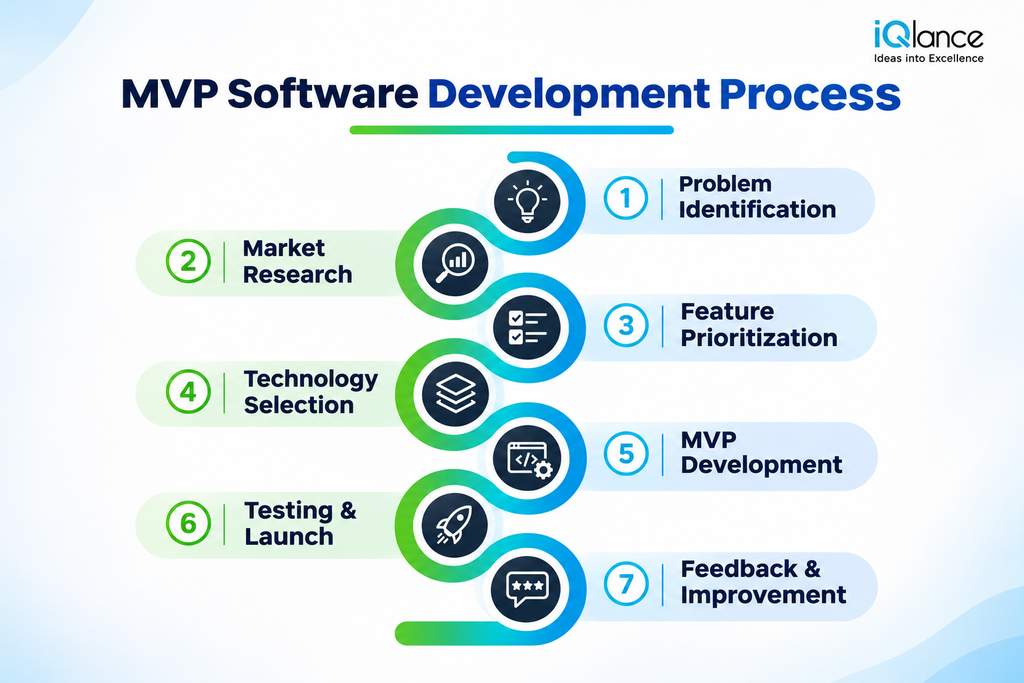
An MVP is more than just coding. To ensure businesses understand their users, choose the right features and plan each development phase strategically.
Below are the seven steps to be taken.
First, turn your product idea into a problem. Recognize the audience for this problem and its needs.
Research your target audience. Discuss with the users and understand their problems.
There are three reasons to conduct a study before development. Analyze current products and services for customers.
Determine existing solution gaps. Understand existing and desired behaviours of the user.
List features that your product may have. Then, determine the essential features and the additional features.
Create functions that meet the simple users' requirements. For instance, a food delivery MVP should include features like restaurant listings, menu options, and ordering. Loyalty programs and complex suggestions can come later.
Choose the right technologies for the product. Consider languages, frameworks, databases and cloud.
Consider growth, performance, and security.
Begin with wireframes and user flow designs. They represent the user "path" through the product. Build a simple user interface that makes critical tasks easy to complete.
Then build the frontend, backend & integrations required. A good Software Development company can help handle this process. Businesses can also hire software developers with the right technical skills.
Test the product before release. Review its main features, functionality, security and ease of use.
Address critical problems prior to launch. Afterwards, present the MVP to some target users.
Monitor user activity with the product. Track participants, users, conversions and engagement.
Use feedback via surveys and user interviews. Apply this information to make changes to present components and future improvements.
The business cannot make a full product to test a new product idea. It may begin with a simple model focused on a specific topic. It can then look at what is happening and make adjustments and improvements.
The first question Airbnb asked itself was, "Would travellers want to stay in someone else's home?
The idea was trialled with a simple website and a sharing of their air mattresses in their flat. Three visitors made their reservations for a conference.
It was then that they came to understand the necessity of such a place. They were able to develop it into a larger booking site.
What businesses can learn:
Test your idea with real customers before building a complete product. Their feedback can help you understand whether your solution meets a real need.
Dropbox wanted to provide a more convenient way to store and access files on various devices.
The team first made a short video to demonstrate the product before implementation. The video attracted strong interest. Overnight, the beta waiting list grew from 5K to 75K people.
It wasn't a working MVP. A way to gauge customer interest before investing in development.
What businesses can learn:
You can gauge what people want before coding software. Show if your idea is useful with a simple video or demo.
Uber set out to make private car booking easier. Its first service linked consumers with professional drivers via an iPhone app in San Francisco.
The service initially focused on luxury car rides. It had less functionality than it does now. This allowed the company to start with a clear intent and a strong understanding of customer needs.
What businesses can learn:
Begin with a specific customer segment or area. This will make the initial launch much easier to handle. You can gauge how customers will react before expanding.
Zappos wanted to test whether people would buy shoes online.
The founder did not purchase much stock; instead, he built a website. He showed photographs of shoes in various stores. When a customer ordered, he purchased the shoes at the store and shipped them.
This enabled him to test real sales instead of building up a big stock.
What businesses can learn:
Run a test to see if customers are willing to pay before investing big bucks. Start with an easy way to take orders and retain customers.
The examples below show how businesses can test new ideas by choosing to hire software developers who understand their goals and customer needs. Keep things simple, gather customer feedback, and use those insights to improve your product. This approach helps reduce development costs and avoid unnecessary features.
An MVP helps businesses test product ideas before investing in full development. However, poor planning can affect the results.
An MVP is too complicated by too many features. It also reduces development time and costs. Pay attention to the most important aspects that address the primary user issue.
Before development starts, businesses should know what they want to test. Without clear goals, it's hard to assess results. Set your main MVP objective right from the start.
An MVP can't be feature-rich, but it must perform correctly. Yes, performance problems, bugs, and confusing design can affect the user experience. Simplicity and security are key.
Developing an MVP is just the start. Businesses need to understand how users react to it. Apply customer feedback to guide enhancements.
MVP software development can help a business test an idea without building a complete product. It clarifies user needs, minimizes risk, and enables better development decisions.
It's nice to have a base to build on. Custom MVP software development services can convert business ideas into functional software solutions with the proper approach.
Looking to develop your MVP? Contact iQlance to discuss your project.
The cost of creating an MVP software development cost ranges between $15,000 to $150,000. Features, design and integrations increase the complexity of the software and therefore increase the cost of development. A simple MVP that contains less features and design would require less investment compared to a more complex one.
An MVP usually takes between 6 and 8 weeks to develop, with more complex projects taking longer to complete. There are many factors that affect development time for an MVP including the number and complexity of the features, design, the development and test teams' availability and capacity, and other resource constraints.
Success of the MVP software development process will be determined by your business and product goals. Some important metrics will be:
Tracking these metrics helps businesses understand consumer behavior better and enhance their product offerings.
Depending on the product idea, how the market is validated and what needs to be built, there are a few variations of an MVP.
Developing MVP software can help businesses show investors a working example of their idea. From here, investors can evaluate demand in the market, gain early user feedback and see initial user traction. Investors aren’t able to judge the potential of an idea like an entrepreneur can, but developing an MVP can help validate some of those assumptions and give investors the confidence they are looking for to make an investment.
MVP software development with AI can improve functionality, efficiency and user experience with your product. AI can help provide recommendations and predictions and can even enhance search functionality.
For example, AI chatbots can be integrated to create customized user experiences. It is important that the initial version of the product remains simple and that AI is integrated to complement and support the main function of the product, as opposed to adding excess complexity.
When creating an MVP, many mistakes are made that drive up costs and delay release. Mistakes include:
These mistakes can be useful to define the priorities and implement features that fulfill the users' real needs.
Yes, an MVP can be expanded upon and transformed into a larger software product over time. Additional features can be added and existing features improved or modified. Once the market has validated the core idea, a product can be improved and modified in numerous ways including enhanced performance and security. Future upgrades are easier because of the modular nature of the architecture.

About the Author:
B.Eng., MBA
I’m Krunal Vyas, IT Consultant at iQlance Solutions. Is one of the name of website and Mobile app Development, I’ve helped more than 250+ Clients to build meaningful mobile apps and website. Call me today for FREE CONSULTATIONS:


Have a look at the services and development process of the iQlance solutions. See What process we follow for mobile app and software development. Have a look at how we are praised by our clients Start a conversation to innovate your next great idea into reality with us.

Dallas
New York
Austin


© Copyright 2026 iQlance Solutions LLC. All rights reserved
Follow us on


 +1 469 793 9837