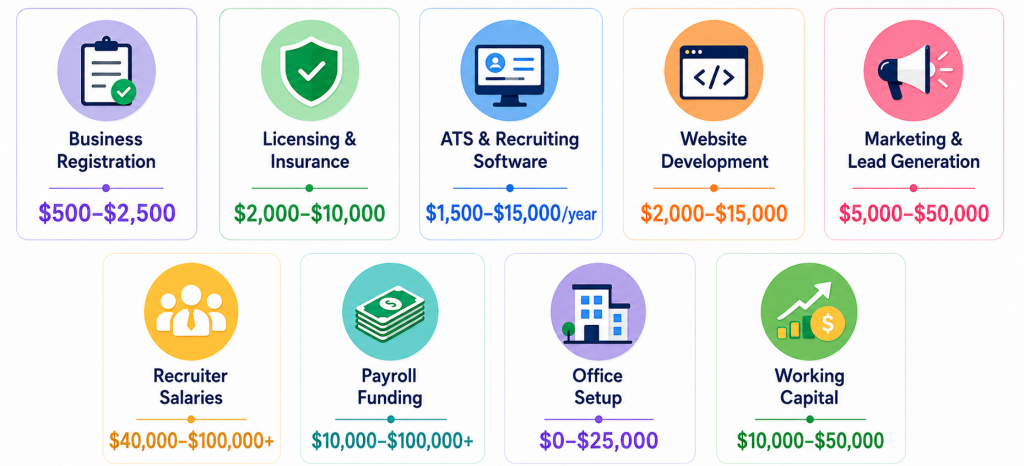
A staffing agency startup costs typically range between $25,000 to $75,000 and more, depending on your business niche, model, and scale. You have to consider the cost of registration ($500-$2500), the cost of licensing & insurance (nearly $2k to $10k), recruiting software ($1500-$15k/year), marketing costs ($5k-$50k), and payroll funding ($10k-$1 million or more). An IT staffing agency needs higher working capital temporarily (during the initial period) due to weekly payroll obligations.
If you are asking how much does it cost to start a staffing agency in the USA, I will answer: approximately between $25,000 to $75,000. The following image breaks down a typical staffing agency budget, so you can see exactly where your investment goes before you commit to any business model.
The launching budget is different for each staffing agency in the USA, which is why a single number rarely answers the question of how much it costs to start a staffing agency.
Recruitment agency startup costs depend on the niche you choose, the placement model you run, and how much technology and marketing infrastructure you build from day one. A solo recruiter placing accountants on a contingency basis can realistically start for under $15,000.
An IT staffing firm that runs payroll for 30 contractors needs six figures of working capital before it places its first candidate. The gap comes down to a handful of cost drivers that compound on top of each other.
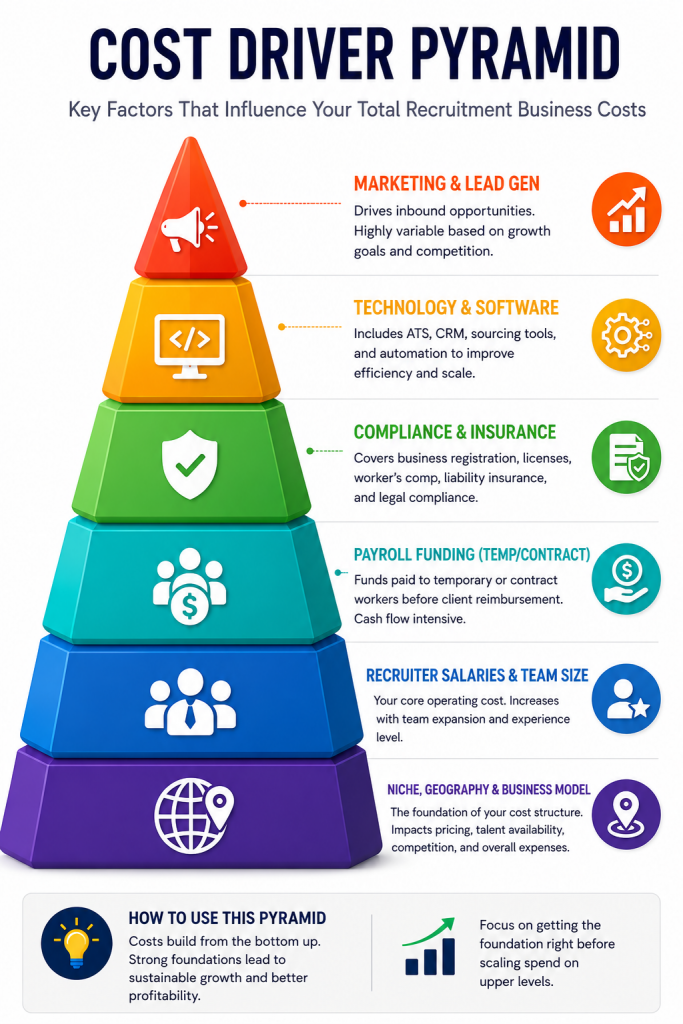
The base of the pyramid, your niche, geography, and business model, determines everything stacked above it. Get this foundation right, and every other cost becomes more predictable.
Read Blog.. Top 10 IT Staffing Companies In The USA
Forming your staffing agency in the USA as a legal entity is the first real expense, and it’s usually the smallest. Core items include:
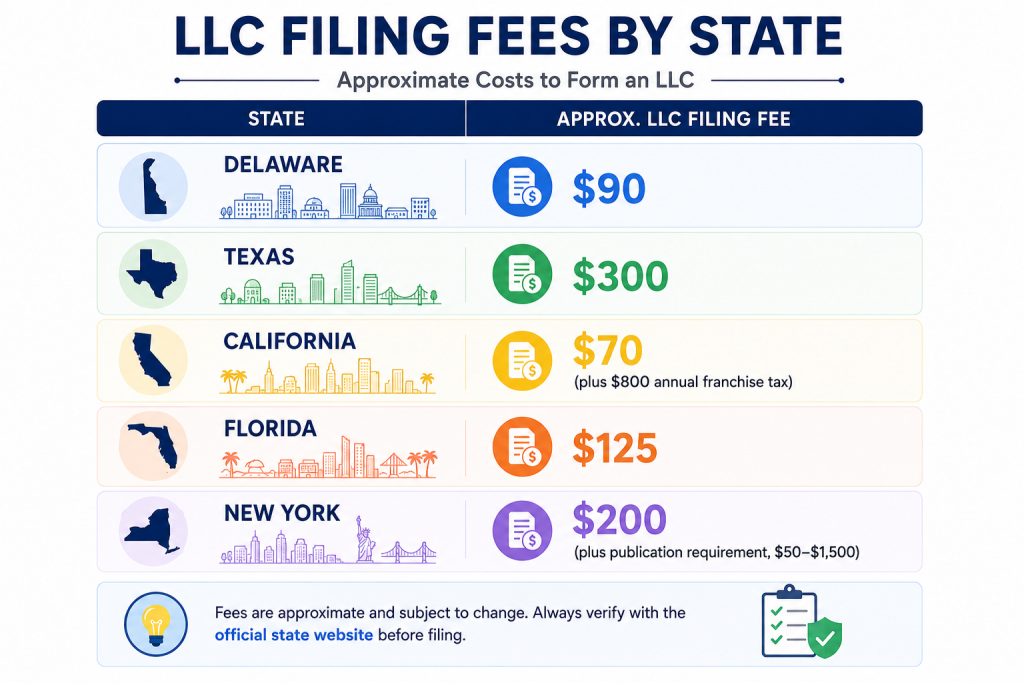
Total registration and legal costs generally fall in the $500-$2,500 range for a single-state launch.
This is the category most new agency owners underestimate, and it’s also where ongoing costs grow the fastest as you place more workers.
Core insurance and compliance requirements include the following:
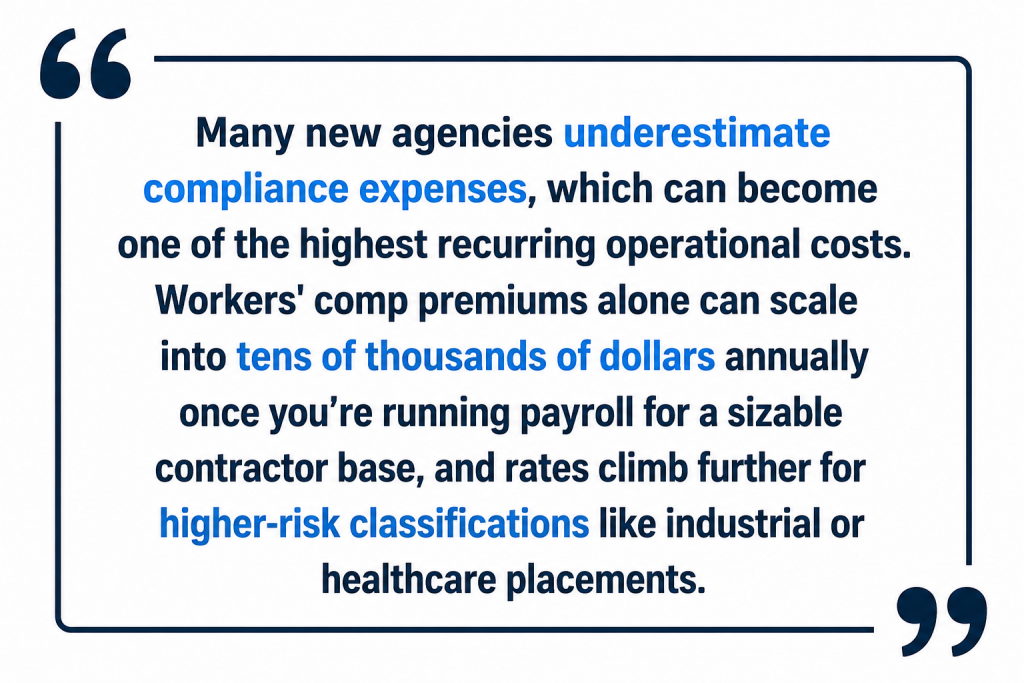
Combined, initial licensing and insurance costs typically run $2,000-$10,000, with workers' comp premiums recurring monthly or quarterly based on payroll.
The tech stack you choose will be the operational backbone of the whole digital system of the staffing agency of the USA. The minimum viable stack includes an Applicant Tracking System (ATS), a CRM for client relationship management, sourcing tools, and verification services.
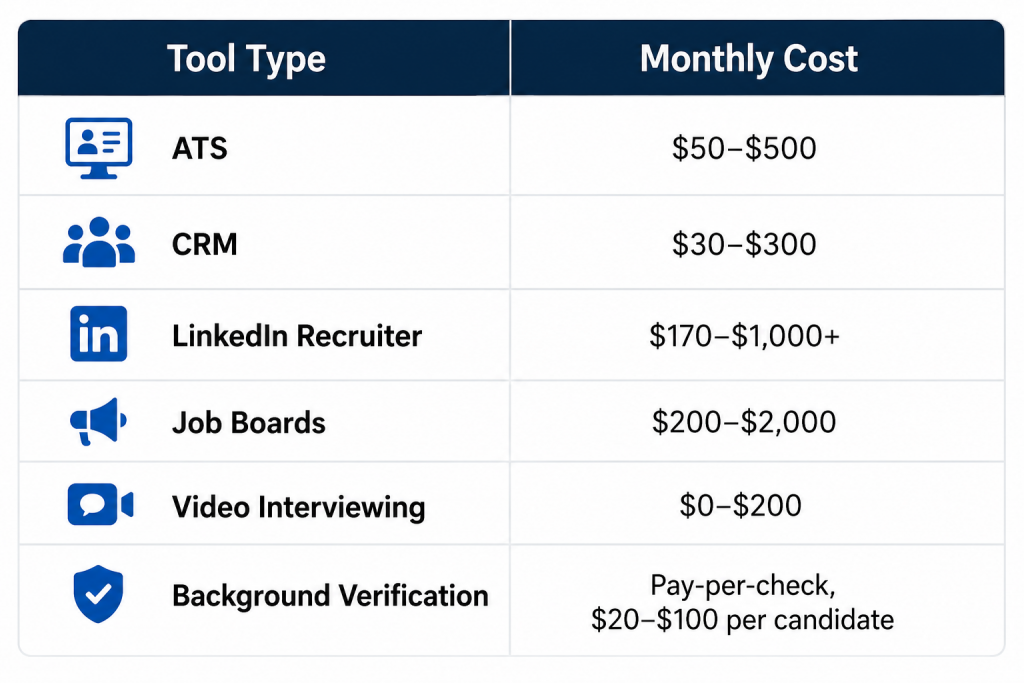
Annually, this adds up to roughly $1,500–$15,000, depending on how many seats and premium tools you license. Agencies scaling beyond a handful of recruiters often find off-the-shelf tools start to break down, sourcing data doesn't sync with the CRM, client portals feel generic, and reporting requires manual exports.
Your website is often the first impression a prospective client or candidate has of your agency, and for B2B staffing, it needs to do more than look professional. It needs to function as a lead-generation and credibility tool.
A basic informational website typically costs $2,000-$5,000, while a more advanced site with integrated job boards, candidate application portals, and CRM connections can run $5,000-$15,000.
As agencies grow, many find that template-based websites and disconnected software tools start to limit how efficiently they can manage candidates, clients, and placements. This is why a growing number of staffing firms partner with a professional software development company to build the following:
For agencies testing a new niche or service line before committing to a full platform build, working with an MVP development company in the USA to launch a lean, functional version first can validate demand without the cost of a full custom build.
App development cost for a custom candidate portal or staffing platform in the USA typically ranges from $10,000-$50,000 depending on complexity, integrations, and whether you need both web and mobile app development for recruiters and candidates on the go. Partnering with an experienced software development company also means your platform can grow with your agency, rather than needing a rebuild every time you add a new feature or job board integration.
B2B staffing is a relationship-driven, competitive space, and most agencies need a multi-channel approach to generate consistent client leads.
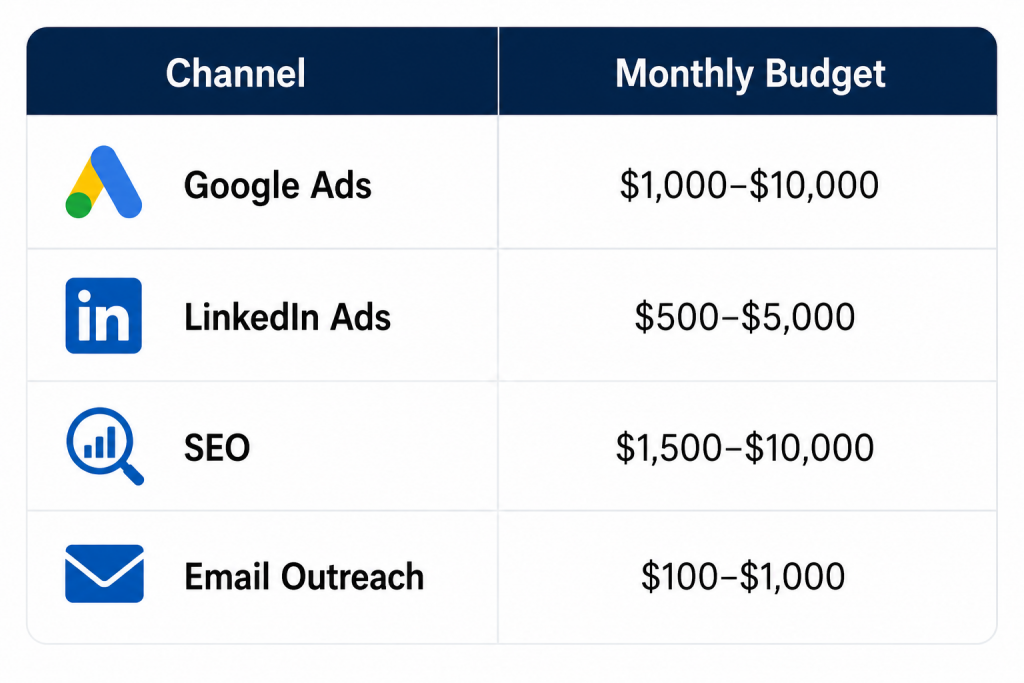
Two metrics matter most when evaluating marketing spend:
Varies widely by niche, but B2B staffing leads often range from $50–$300 depending on channel and targeting.
Factoring in the full funnel (lead → client meeting → job order → placement), agencies often see acquisition costs of $500-$3,000 per filled role, which is typically recovered through placement fees of 15%-25% of first-year salary (or markup percentages for contract roles).
Total marketing budgets for new agencies generally fall between $5,000 and $50,000 annually, with the higher end reflecting agencies pursuing enterprise clients in competitive verticals like IT staffing.
Even a lean staffing agency needs people to source, screen, and place candidates. Core roles include:
A single recruiter's base compensation (often plus commission) typically falls in the $40,000-$100,000 or more range depending on experience and specialization, with IT and executive search recruiters commanding the higher end.
Approximate Cost Allocation for a New Agency:
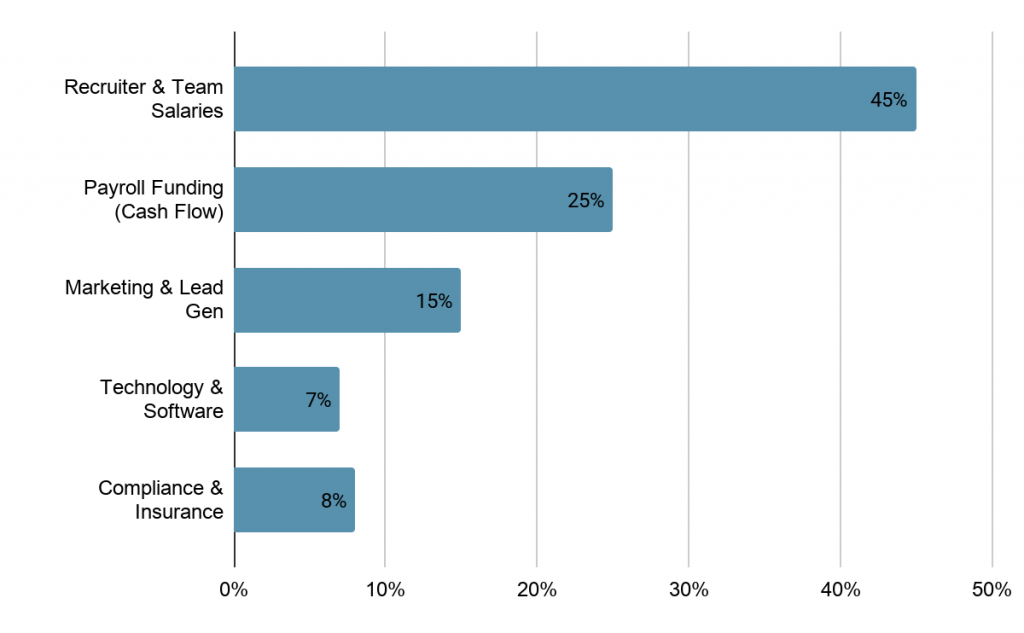
This breakdown illustrates why salary and payroll funding together often represent 70% or more of a staffing agency's startup capital, far surpassing software or marketing in raw dollar terms.
This is arguably the most important and most overlooked cost category for any temporary or contract staffing agency.
Here's the core challenge: clients typically pay invoices in 30-90 days, but contractors expect weekly or biweekly paychecks. That means your agency must front payroll out of pocket for weeks before reimbursement arrives. The larger your contractor headcount, the bigger this gap becomes.
Example Scenario: Weekly Payroll Obligations
| Contractors | Estimated Weekly Payroll |
|---|---|
| 5 | $8,000 |
| 10 | $16,000 |
| 25 | $40,000 |
At 25 contractors with a 60-day client payment cycle, an agency could need $240,000-$320,000 in payroll funding capacity before the first invoice is paid, a figure that often surprises new owners who only budgeted for software, marketing, and salaries.
This is also why many new agencies start small (5-10 contractors) or focus on permanent placement models that don't carry this cash flow burden, while gradually building toward contract staffing as working capital grows or financing partnerships are established.
Not all staffing businesses carry the same financial profile, and the staffing agency startup costs in the USA vary significantly depending on which model you choose. Here's how startup costs vary across common models:
Startup Range: $10,000–$30,000
Lowest barrier to entry. You collect a one-time placement fee (typically 15%-25% of first-year salary) with no payroll funding obligation. Ideal for solo recruiters or small teams focused on direct-hire roles.
Startup Range: $50,000–$150,000+
Highest cash flow requirement due to weekly payroll for W-2 employees. Requires workers' comp insurance, payroll processing infrastructure, and substantial working capital reserves.
Startup Range: $15,000–$75,000
Focuses on senior-level, often retained, searches. Higher placement fees (often 25%-35%) offset a longer sales cycle and more intensive research/sourcing requirements.
Startup Range: $25,000–$100,000+
Combines elements of permanent and contract staffing. Higher-paid tech talent means larger payroll funding needs for contract roles but also higher placement fees and markup percentages, alongside strong demand from B2B clients.
| Business Model | Startup Range | Payroll Funding Needed | Revenue Model |
|---|---|---|---|
| Permanent Placement | $10,000 to $30,000 | None | One-time fee per hire |
| Temporary Staffing | $50,000 to $150,000 or more | High (weekly) | Markup on hourly billing |
| Executive Search Firm | $15,000 to $75,000 | None | Retainer + placement fee |
| IT Staffing | $25,000 to $100,000 or more | Moderate to High | Markup + placement fees |
Above the line items above, many recurring or one-time costs catch new owners off guard:
Skipping office space saves $0-$25,000 immediately. Most staffing functions, sourcing, screening, and client calls, can be done remotely with the right software.
Cloud-based ATS and CRM platforms eliminate the need for on-premise infrastructure and scale with monthly subscriptions rather than large upfront licensing costs.
Specializing reduces marketing waste, builds recruiter expertise faster, and improves placement rates, all of which lower your effective cost per placement.
Payroll processing, bookkeeping, and compliance filings can often be outsourced cost-effectively, freeing up capital for recruiting and sales.
Rather than investing in a full custom staffing platform on day one, businesses often validate hiring demand and workflow assumptions through lean technology solutions developed by an experienced MVP development company before investing heavily in infrastructure. This approach lets you test candidate portals, client dashboards, or automated matching features at a fraction of the cost of a full build and scale only what proves valuable.
The data suggests yes, with limitations around competition and technology adoption.
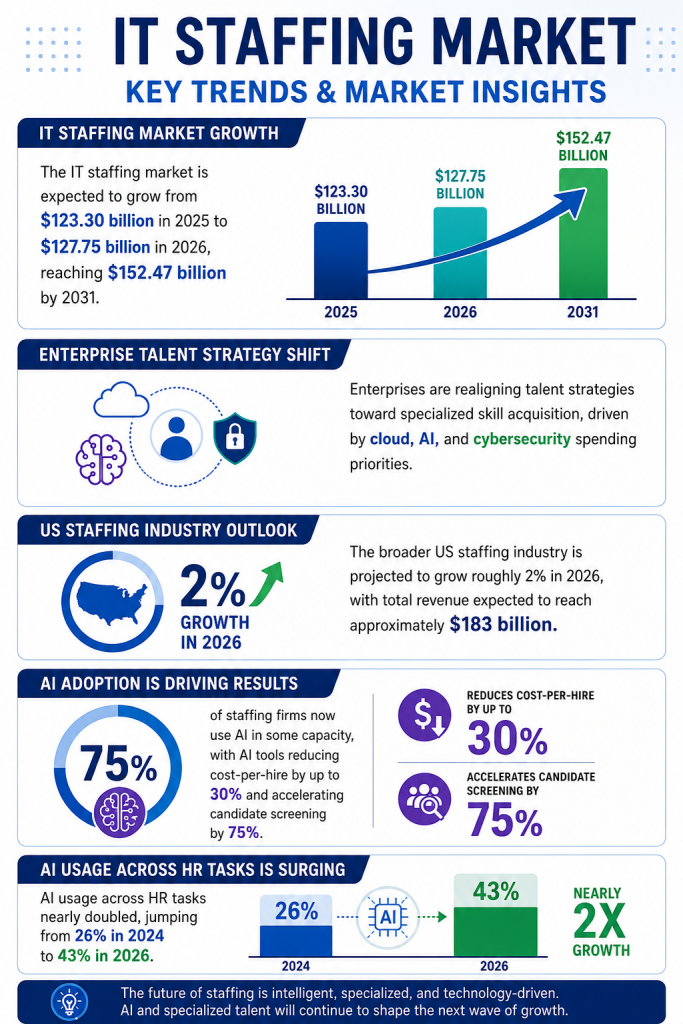
(1) Market Growth: Steady, multi-year growth driven by enterprise demand for specialized tech talent.
(2) Demand for Tech Talent: Generative AI engineering, edge computing, and cyber-resilience needs are reshaping job requisitions, while persistent global skill shortages sustain upward wage pressure.
(3) Remote Hiring Trends: Distributed teams have widened the talent pool but also increased competition for top candidates.
(4) AI-Driven Recruitment: AI-powered sourcing and screening tools are becoming table stakes, not differentiators.
For businesses, this means the opportunity is real, but success increasingly depends on technology adoption, niche specialization, and the ability to move fast on placements.
For businesses on the other side of this metric, companies that need tech talent, it also explains why partnering with an established IT staffing agency is often more practical than building an internal recruiting function from scratch.
For businesses considering how to fill technical roles, the choice often comes down to building an internal recruiting function or partnering with a staffing agency.
| Factor | Internal Hiring Team | IT Staffing Agency |
|---|---|---|
| Time to Hire | High | Lower |
| Recruiting Cost | Higher (fixed salaries, tools, overhead) | Predictable (fee-based) |
| Scalability | Limited (hiring/firing recruiters is slow) | Flexible (scale up or down per project) |
| Access to Talent | Limited to internal network and job boards | Larger Network across active and passive candidates |
Building an internal team means taking on recruiter salaries, ATS licenses, sourcing tool subscriptions, and compliance overhead, many of the same costs outlined earlier in this blog, even when hiring needs are seasonal or project-based.
An IT staffing agency in the USA, by contrast, spreads those fixed costs across many clients, passing the efficiency back to you through predictable fees and faster turnaround.
This is why companies increasingly partner with an IT staffing agency rather than investing in additional recruiter headcount, particularly for specialized or short-term technical needs.
For US-based businesses considering their hiring strategy, partnering with a local IT staffing agency like iQlance Solutions offers many obvious advantages over building recruiting capacity in-house:
For businesses searching for IT staffing agencies near me or comparing IT staffing companies in the USA, the underlying calculation is the same one outlined throughout this blog: building an internal recruiting function carries the same costs, salaries, software, compliance, and payroll funding that staffing agencies have already utilized and optimized at scale.
So, how much does it cost to start a staffing agency? As this guide shows, the answer generally falls between $25,000 and $75,000 for most US businesses, though the actual figure depends on your business model. Permanent placement agencies can launch on a modest staffing agency startup budget in the USA, while temporary and IT staffing agencies need substantial working capital to cover the gap between weekly payroll and 30-90 days client payment cycles.
Across every model, the biggest cost drivers consistently come down to payroll funding, recruiter salaries, marketing, and compliance, not software or office space. Technology choices, from ATS platforms to custom staffing portals built with a reliable software development company in the USA, can either streamline these costs or compound them, depending on how well your systems integrate.
For many US businesses, this is exactly why the math increasingly favors partnering over building. Rather than covering the full cost structure of recruiting, including software licenses, compliance overhead, payroll funding, and dedicated headcount, companies are turning to established IT staffing agencies to access skilled developers, engineers, and technical specialists on demand.
iQlance Solutions works with US-based businesses as a staffing partner, connecting companies with vetted in-house mobile app developers, software engineers, QA specialists, and DevOps talent without the overhead of building an internal recruiting function. If your business needs technical talent faster and more predictably than an internal hire could deliver, get in touch with our IT staffing agency to discuss your hiring needs.
(1) What is the minimum budget required for a recruitment agency?
A lean, permanent-placement-focused recruitment agency can launch with a minimum of $10,000-$15,000, primarily covering registration, basic software, and minimal marketing.
(2) Do staffing agencies require licenses?
Requirements vary by state, but most staffing agencies need general business licenses, and temporary staffing agencies employing W-2 workers must carry workers' compensation insurance and comply with state employment regulations.
(3) How much working capital do staffing agencies need?
Working capital needs depend on contractor headcount and client payment terms. As a guideline, agencies should budget for at least 60-90 days of payroll obligations as a cash reserve, which can range from $10,000 to over $200,000 depending on scale.
(4) Can I start a staffing agency from home?
Yes. Many staffing agencies, particularly permanent placement and executive search firms, operate successfully as home-based or fully remote businesses, especially in the early stages.
(5) What is the startup cost of an IT staffing agency?
IT staffing agencies typically require $25,000 to $100,000 or more to launch, with costs at the higher end driven by payroll

About the Author:
B.Eng., MBA
I’m Krunal Vyas, IT Consultant at iQlance Solutions. Is one of the name of website and Mobile app Development, I’ve helped more than 250+ Clients to build meaningful mobile apps and website. Call me today for FREE CONSULTATIONS:



Have a look at the services and development process of the iQlance solutions. See What process we follow for mobile app and software development. Have a look at how we are praised by our clients Start a conversation to innovate your next great idea into reality with us.

Dallas
New York
Austin


© Copyright 2026 iQlance Solutions LLC. All rights reserved
Follow us on


 +1 469 793 9837


